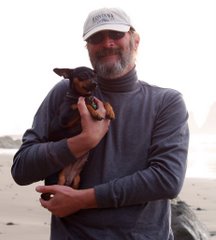
Sunday, January 7, 2007

More winding roads

The Last Chance Section of the Coastal Trail
Redwood National and State Parks
Crescent City, California
1/7/07

Crescent City is not known as a gastronomic paradise, but there are a few restaurants that are worth a visit, so when my friend Bear invited me to join him for Sunday brunch at the Surfside Grill, I happily agreed. I’ve wanted to try their brunch for several months, but the first time I went by it was 11:00, I was hungry, and the sign said they opened at noon. Unfortunately hunger won out and I ended up at Denny’s. In early December, I attended the symphony concert with my friends Steven and Carl, and afterward we headed to the newly opened Ambrosia Grill, but it was closed. Surfside Grill, however, was open, and we had a delightful dinner. This morning, knowing that we wouldn’t get into the restaurant before noon, I agreed to pick Bear up at 11:45.

When the morning dawned dry, if not sunny, I packed Gypsy and the camera gear in the car. My thought was that I might grab some shots before breakfast, so I headed for the south side of Crescent City—Endert’s Beach to be exact. Endert’s Beach is the southern end of the crescent shaped bay that gives Crescent City its name. It is also the viewpoint where my favorite area photograph was taken—one where the Battery Point Lighthouse and the St. George Reef Lighthouse appear to be close together. I wanted to see if I could even begin to duplicate that shot. Admittedly, in order for the two-lighthouse shot to work, you have to have a much longer lens than I own, but nothing ventured nothing gained.

Only once before had I visited this area, and then I never left the flat land adjoining Crescent Beach. This morning, I drove to the end of the road—a road that must be an older version of US 101. Turning off 101 at Endert’s Beach Road, I drove for a couple of miles, passing a very small brown sign that read “Redwood National and State Parks.” So much for the entrance gates at West Yellowstone. If you blinked, you’d never know you were now in one of America’s National Parks. Passing the trailheads leading to the beach, the road leaves the coastal plain and starts climbing. Perhaps a mile further on, you reach the end of the road, and a beautifully landscaped parking and viewing area. Gypsy immediately jumped out of the car and went to investigate, while I gathered my camera gear. A trail leads on from the parking area, posted with several signs indicating that even on a leash, dogs are not welcome. Now personally, I can’t imagine how anyone could object to Gypsy, but not wishing to incur the wrath of any Park Rangers, I cajoled her back into the car, where I left her crying while I went off in search of the perfect shot.

Now if you’ve been reading my blogs, you’ll recall that yesterday I said I didn’t need any more seascapes. So where am I but on the shoreline. And what a wonderful shoreline it is. I used to say that living in Montana, the two things I missed from California were my mother and the ocean. In January 2000, Gary and I headed out to a New Image National Conference in Daytona Beach, Florida. Sitting in our motel room, looking out over the Atlantic, I realized that it was not the ocean I missed. It was the Pacific coast of California and Oregon. I just can’t get enough of it. Even now, having spent the past 11 months on the coast, I never tire of it. It helps that we haven’t had the torrential rains I remember from my college days. But sun or fog, mist, haze, overcast skies, the coast is ever changing.

Having enjoyed the viewing platform built out over the cliffs, I headed back to the car and beyond—going through the stile and heading down the Coastal Trail. A sign informed me that I was on the “Last Chance” section of the Coastal Trail—which means, I presume, that there is no trail north of here in California. Of course, there’s only about twenty miles left in California at this point, and most of that is coastal plain and urban sprawl. Another sign told me that “Nickel Creek C.G.” was a half mile ahead, and that I’d meet US 101 after 6 miles of hiking. Now remember, I had a brunch date, so hiking 6 miles to 101 and 6 miles back was out of the question. But the chance of seeing a Coast Guard station, even an abandoned one, was certainly worth a ½ mile trek. The trail was exactly the kind I love—wide with gentle slopes, and the occasional PRECIPITOUS DROP where most of the trail has fallen into the sea. In short it’s one of those trails where you can walk and dream, as long as you keep one part of your mind open to the chance of nightmares. Lots of rocks along the way, and lots of trees. Of course there was a whole ocean of water—so my favorite photographic subjects were plentiful. And in no time, I had snapped 75 shots of trees, rocks and water. Some of them are quite lovely, if I do say so myself. Eventually I reached a cross in the road with signs pointing to the “Coastal Trail,” the “Creekside Trail,” the “Beach,” and the “Camp Ground.” Oh, that’s what the C.G. meant. It’s not a Coast Guard station at all. Well, I am in a National Park.

At this point, I knew I’d have to turn around if I was going to pick up Bear at the appointed time. But maybe just a little way up the creek. OK, got some shots of the creek and the velvet covered tree trunks. Well, maybe just a few steps further up the Coastal Trail. Aha! There’s the view of the waterfall I wanted to get. Well, I can’t go to the beach, and besides, it’s high tide. There is no beach, but maybe if I walk down the trail I can get some different shoreline shots. Oh what the heck. The beach is right there. Go look. And yes, as I walked back from the beach, I stopped to check out the camp ground as well. Nice place. I recommend it. In fact, I think I may have to camp out there myself one day soon.


Rock and wood. Two of my favorite subjects.
I thought this looked rather like a dog with a bone.
Endert's Beach, Redwood National and State Parks
Crescent City, California
1/7/07

By this time I was seriously in danger of leaving Bear standing by the side of the road wondering where I was. Yes, I do have a cell phone. You may call me at that number any time you wish. If I’m not in the car, however, I won’t get your call because I never take the phone out of the car. I’m at least a half mile from the car, a half mile of uphill trail. The car is at least six miles south of Crescent City and Bear is at least four miles north of Crescent City. I have twenty five minutes to cover this distance. Will I make it?

Well, yes, I did. Once I reached the car, I called Bear and explained that I might be a bit late. As it turned out, I was right on time. Bear climbed in the car and we headed to the Surfside Grill where the sign now read “Open for lunch and dinner Tuesday through Saturday.” No brunch today. Damn. Well, how about the Ambrosia Grill. No, it too was dark. I know, the Grotto. But, once more the lights were off and no one was home. We ended up back at the Northwoods where we had not enjoyed Thanksgiving dinner. Bear had been so displeased with his turkey loaf and moistened crouton holiday dinner that he made sure the waitress knew he was not a happy camper. But that was then, this is now, and the Northwoods, seemingly alone among Crescent City restaurants, was open for Sunday dinner. And it was good. We both chose the almond-crusted halibut with raspberry pepper sauce. I can heartily recommend it. Dinner finished, I returned Bear to his cave and homework, and headed back south of town to see if I could catch some surfers in my lens.

I have no idea how long I spent on the beach happily shooting away. Got some fun shots, some not so fun shots, and wet shoes, socks, jeans. Well after all, if you’re going to be standing on the beach with your face in the back of a camera, the breakers are going to get you. Once I accepted that, and stopped trying to dance out of their way, everything was fine. I thought I’d get my sneakers wet and I was ok with that, but the waves were a little larger than I had anticipated. Oh well, I haven’t rusted yet. And I came away with 103 shots of sun, sand, sea, and surfers. Most of which will be ignored from this point forward. Considering that by this time of the day I was shooting almost directly into the sun, and considering that the tripod was in the car and not planted in the shifting sands and seawater, I think my hand-held surfer shots came out pretty well. Now with a longer lens…..


Surf's up. Wrist is limp. Yes our surfers wear wet suits.
Crescent Beach, Crescent City California
1/7/07

Well, one last venue to check out. The harbor is always good for a shot or thirty. I love photographing the boats, and you never know when a gull is going to decide to entertain you. I grabbed some shots of gulls, sea ducks, a couple of seals, and lots of boats. I even got some shots of a novel way to walk the dog. Hearing a honking horn, I looked up to see a pickup truck on the beach and a dog running madly away from it. As I watched, the truck picked up speed, chasing one dog while another ran behind. When the truck got to my end of the beach, the driver made a U-turn, and headed back down the beach, this time with both dogs in hot pursuit. Hmm, wonder if Gypsy could keep up with the Volvo???

As I was watching the harbor, I caught a glimpse of a gull landing on a boat and picking up something in its bill. I started shooting, caught the bird as it rose off the water heading toward the dock, and then watched and shot as the gull enjoyed his Sunday dinner. Who knew that starfish were edible? Don’t think I’ll try it myself, but as I watched, that bird ate the whole thing. I can’t believe he ate the whole thing, but I have it fresh from my camera. So, next time you’re on the beach and hungry… Let’s just leave it at that.


Many parts of a starfish are edible.
Thank you Ewell Seagull.
Crescent City Harbor
1/7/07

Weather: Morning overcast clearing to sun and blue sky, 50 degrees
Number of photographic images taken: 252
Happy Camper Index: 10+ on a 1-10 scale

Saturday, January 6, 2007

Shooting--Take Two

Out my study window
Smith River California
Taken 1/6/07

Ernest Dowson, once described as a “rummy English poet,” gave us the title of one of the most famous pieces of American literature. “I have forgot much, Cynara, gone with the wind, flung roses, roses, riotously with the throng.” (The poem has the improbable Latin title: Non Sum Qualis eram Bonae Sub Regno Cynarae.) While my experience of going with the wind is limited to kite flying, windsurfing and sailing, I have definitely forgot much. But I’d like to think that I’ve flung my share of roses. Today I’m flinging a couple to you on this site, and one to the good folk at Eyefetch (www.eyefetch.com). Roses blooming in January has to be one of the joys of living in California—even in the relatively cold part of California known as the north coast. Yesterday, my shooting expedition took me into snow and ice. Today it was azaleas, roses and rhododendron, all in full bloom. And the snow and flowers aren’t twenty miles apart.

As I finished writing yesterday, and went to send the link to my friends, my internet connection crashed. Rather than fight with technology at midnight, I chose to go to bed. After all, tomorrow is another day. This morning, upon arising, I still had no internet connection, but by turning everything off, rebooting the computer, the modem, the wireless router, I was finally able to get on-line long enough to get the paying work done. Even so, my AOL kept closing, and my web sites kept “timing out.” Finally, it all crashed again, and like Humpty Dumpty, all the king’s horses and all the king’s men, this time taking the form of Charter Communications Customer Service, could not get it back up. “We’re not seeing your router,” I was told repeatedly, and prosaicly. Jack at Charter promised to send someone out on Monday to check the lines, and in the meantime, good luck. Had the day been bright and sunny, as Friday was, I would not have been so concerned. There are always pictures to take. But the day was wet and rainy, and I ended up spending the entire morning trying to regain my computer connection. And even without Charter’s help, roughly two hours later, everything was working properly again.


Rose growing on the side of my garage
Smith River California
Taken 1/6/07
(The rose is slightly blurred due to the fact that it is growing some 5 feet above my head and I couldn't control the wind while hand-holding the camera.)

While the day never became clear and bright, the rain did stop. With no fear of water getting into my camera, I ventured out into the front yard to see what might find its way in front of my camera lens. You see, it really is a passion for me. I’m never outside without a camera these days. You just never know when a hawk is going to be tearing into some road kill right next to the highway. (Caught that with the L3.) You never know when a scrub jay is going to land in your hedge. (Caught that too, with the D80.) You never know when the perfect rose, or wave, or sunset is going to appear right in front of you, so you have to be prepared. (That is, after all, The Boy Scout’s Marching Song—pace, Tom Lehrer.)

This week our local PBS station, KEET in Eureka, California, showed the American Masters episode featuring photographer Annie Leibovitz. My friend Carl, one of those “friends like you” who has contributed to KEET, called my attention to the program. Of course I watched it. Annie Leibovitz IS American photography in my book. The program showed the wide range of her work, from family snapshots to Vogue magazine spreads set at Versailles, and of course the Lennon/Ono portrait where John Lennon is nude and curled up, looking for all the world like a human chambered nautilus stuck on the side of Yoko Ono. While I have to admit that Leibovitz’s portrait work is stunning—the epitome of modern American portraiture—I found myself saying “I never want to work like that.” Don’t get me wrong, I’ll happily spend hours, days, weeks, camera in hand, shooting madly away. On the other hand, the idea of directing others to stand here, slouch there, put this on and sit at Meryl Streep’s feet, just leaves me cold. Well, maybe the latter if I get to meet Ms. Streep. Similarly, Jack Hollingsworth, of whom I wrote yesterday, explains that his "photo" work includes hiring hairdressers, costumers, models, extras, etc. all in the attempt to get the shot the paying customer wants. Fine. Go, do that. It’s not for me—at least not at this point in my “career.” I prefer being the photographer of found objects. Yesterday, I argued with myself if it were permissible to move a rock out of the shade so I could capture its colors.


Weeping Rose
Taken across the street from my house
Smith River California
1/6/07

Watching American Masters did get me to thinking. What is it I like to “capture” with my camera? Well, if I were to put it in one word, “nature.” I love rocks, wood, water. Twisted dead trees—or what my online friend Ed calls “gnarly old wood”—are a favorite subject. I’ve been known to take my share of architectural shots, though in general I much prefer being in the countryside to being in a city. I love those items that are out of place—roses in January, for example. And with the wonderful “Night Landscape” setting on my D80, I’ve discovered the joy of evening, even nighttime shooting.

This evening, as I headed into Brookings for some shopping, I grabbed the camera bag—of course I did. It was still light and there was the chance of getting some good seascapes. But ya know, I have hundreds of seascapes in my portfolio. I don’t need (and “need” is the operative word) one more village in Austria seascape. ("Village in Austria" is a euphemism for the “F” word. Apparently there is a town not far from Salzburg with a highly unfortunate name—at least if you’re a speaker of English. Henceforth, whenever I feel the need to use the “F” word, I’ll just say “village in Austria” instead.)

One of the interesting aspects of the online peer review site “Eyefetch” is that you can join different groups. There are groups for people interested in landscapes. Groups for people interested in experimental photography. Groups for sunsets, sunrises, bridges, trains, you name it. One group is dedicated to people who like to take city street scenes. Driving through downtown Brookings this evening, I seriously considered parking the car, setting up the tripod, and just sitting on a bench shooting everything that passed by. Instead, as I was leaving Freddy’s (the local Fred Meyers Store), the steam rising from the South Coast Lumber plant caught my eye. The sky was dark, but the plant was lit for night work. The rising steam caught the work lights and shone brightly in the sky. I grabbed the camera, set it for “Night Landscape” and shot away happily. One of the pics in particular is quite dramatic and I’ll be sharing it with the Eyefetch folk. That got me to thinking about what other night scenes might be of interest, and I immediately thought of the harbor. Picking my way nervously along the docks, fearful of dropping camera and tripod into the drink, I got several shots of the harbor lights, including this one with the sailboat Torrey Pines in the foreground and a working fishing boat all lit up for night work in the back. At the top of this page is a pic I took standing up at my desk and looking out the window in front of me. There are pictures everywhere. All you need to do is shoot.


Harbor Lights
Brookings/Harbor Boat Basin
Harbor Oregon
Taken 1/6/07

By the way, Ernest Dowson is also responsible for the title of a Blake Edwards 1962 film starring Jack Lemmon and Lee Remick. In my opinion, the poem is much more meaningful than the movie. The poem , barely longer than its title Vitae Summa Brevis Spem Nos Vetat Incohare Longam, is reproduced in its entirety below:

They are not long, the weeping and the laughter,
Love and desire and hate;
I think they have no portion in us after
We pass the gate.

They are not long, the days of wine and roses:
Out of a misty dream
Our path emerges for a while, then closes
Within a dream.

Friday, January 5, 2007

Shooting--as in Photography

Sign posted at staging area
North Fork Smith River
I hope they didn't mean me!
Taken 1/5/07

When passion kicks in, every thing else tends to fly out the window. If you are fortunate enough to have found passion in your life, nurture it. Nothing else truly matters. For me, photography has become my passion. When I’m out in search of the perfect shot, I lose track of time, hunger, thirst. And since I usually have Gypsy with me, let’s hope she loses any interest in food or water too. Unfortunately for her, I tend to forget that she has food and water in the car, just not where she can get to it.

Thank God for digital cameras. Today I shot 232 pictures with the Nikon D80 Digital Single Lens Reflex and 6 with my Nikon Coolpix L3. That’s roughly the equivalent of ten 24-exposure rolls of film, or $120 in developing and printing costs had I been using 35 mm film. But cost isn’t, or at least shouldn’t be the issue. The matter at hand, always, is quality. Have I found anything at all worth sharing? Do any of these pictures tell the story I want told?

Recently I read an article in the December 2006 issue of Shutterbug magazine where photographer Jack Hollingsworth states that since he went digital he shoots two to three thousand photographs a day. I immediately felt like a piker. I’ve been shooting roughly 200 a day since I got the L3 back in October. I worry that I’ll run out of space on my hard drive as I diligently transfer the pixels from camera to computer. Of course other than a paycheck, and a very handsome one at that, what sets Jack Hollingsworth apart from happy snappers like me is that he has paid assistants who go through those thousands of images daily, discarding the ones that just don’t make it.

Having an assistant is only one answer, though, to the problem of too many images. When I ran my idea of becoming a travel writer/photographer past my friend and former co-worker Dennis Kern, Dennis, a photography professor at Montana State University—Billings, suggested that the ease of snapping digital images can be a trap. Instead of taking the time to find exactly the right shot, we just shoot away happy in the knowledge that we won’t have to develop and print in order to see what we’ve shot. Actually, most digital cameras these days are so sophisticated that you don’t even need a computer. You can do just about any editing you would want in the camera itself. This is not, however, what I do. Whether it’s my eyes needing further adjustments, or the small size of the camera viewer, or just an innate disinclination to really master all the wonderful capabilities of the D80, I prefer to transfer the pics to my computer and then use the oversized screen and Photoshop Elements to do my editing. Between the two peer review sites to which I submit photos, and this blog site, I need to find 8-9 images daily that please my eye and tell the right story. I find it challenging to narrow 238 photos down to nine.

This morning dawned bright and clear—perfect for catching those morning shots I’ve been meaning to get. Rushing through my morning business, I grabbed the camera gear and my faithful photographer’s assistant, Gypsy, and jumped in the Volvo ready to go where the muse led. I did have a few shots in mind. There’s a great image just waiting for me at the Crescent City Harbor. I’ve already taken the photograph several times—but always with the light in the wrong position. I need to be there in the early morning, and this morning would have been perfect. There’s an image I’m dying to attempt where you catch both of Crescent City’s lighthouses in one shot—but you have to be in a certain location and have a much longer lens than I have in order for that to work. Then there’s the view of Smith River, the fields beyond the town, the river itself, and finally the Pacific.

On a recent photo shoot I headed up Rowdy Creek thinking to turn onto the Low Divide and get some pictures of the coast line from 1500 feet elevation. The snow, however, was too heavy and the road too narrow, so I turned around. Heading back down Rowdy Creek I saw the perfect shot, and actually attempted it. Alas the weather conditions meant that there was a lot of haze and no sun to speak of. Perhaps this morning I could grab that shot then head to the harbor. I was ready to drive to the ends of the earth for sun-lit scenes. Well, if not the end, at least further up the Oregon Coast, or south of Eureka California. But then I realized that spending the daylight hours driving just didn’t make sense if I was really intent on capitalizing on the sunshine. So, back up Rowdy Creek to see what I could find.


Smith River, the Coastal Plain, and the Pacific
Taken 1/5/07 on Rowdy Creek Road, Smith River California

In this shot of the coastal plain as seen from up Rowdy Creek Road, you can see the Pacific in the distance, then the sand spit that separates the ocean from the river. Next comes the river, flowing parallel to the ocean. Inland from that the lily fields that produce 80% of the Easter Lilies sold in the US. Finally, near the foreground, you can see the town of Smith River itself. In fact, in this shot you can actually see the steeple of my father’s last church, and if you know where to look and really enlarge the shot, you can almost see my house. This is the shot I had counted on getting—but again, while we had sunshine and therefore blue water, there was still much too much haze in the air for a truly great landscape shot. I hope you can enjoy it anyway.

Now understand, I haven’t been very far up this road in over thirty years. As I recalled, we drove for quite some time through forests, bare land that had been logged, and past gravel pits, eventually ending up down on US 199 near Patricks Creek. Recently there have been two letters in the Crescent City newspaper suggesting that rather than try to improve 199, a new highway should be built following the old roads I was driving on. These letters suggested that if you went far enough, you’d end up near Cave Junction, Oregon. Ok, I said. Let’s just see where the road leads us and what we find along the way. The Volvo is all-wheel drive, and I’ve never been afraid of mountain logging roads, so what the hey.

On and on we drove, stopping every few miles to get out, set up the tripod, take some shots—ok more than some shots—and let Gypsy run for a bit. The road climbed quite steeply in places, dipped down a ways, then resuming its uphill trajectory. With the sun shining brightly overhead, we drove on dry gravel, bare rock, wet sand, snow. We took pictures of rocks, trees, distant mountains, rushing streams, Darlingtonia (which seems to be on the verge of becoming my signature plant). And then the road started dropping—precipitously. Around another curve or two and a bright blue ribbon of water appeared in the distance. This must be the North Fork of the Smith River. And then we were down at the river’s level. Well, this must mean we’re close to civilization. There’s a white water boat staging area and a National Forest campground here—not to mention a very nice, relatively new bridge. And a very large house behind a fence, a locked gate, and enough Keep Out signs to stock a small store. Surely, if I just cross the river, and head on a ways, I’ll be out of the wilderness and on a paved highway, US 199.


North Fork Smith River
24 miles at 20 mph (max) from US 101
Taken 1/5/07


At mile 28 I had the choice of taking the right fork or the left. Neither looked promising. I had now lost the sun. The road was muddy to the point of being dangerous, and it looked as if storms were approaching. US 199 was nowhere in sight. I turned the car around, parked, and Gypsy and I set out to determine where the right fork might lead. We may have hiked a mile up the road, maybe half that. But all we saw was more of the same, road without end, as it were, twisting and turning, climbing and dipping, but going, as Tolkien put it, ever on.

Leaving further exploration for another day, Gypsy and I headed back to the car where I stowed my gear, put Gypsy in her travel crate, and began the long trek home. Vowing that I wouldn’t stop for any more photo ops, I almost made it. The turnaround photo was number 200 of the 232 on the D80. It was a long day, a richly rewarding day, a day I’d gladly repeat over and over again. In short, it was a day of passion. (More on this subject tomorrow.)


28 miles at 20 mph (max) from US 101
No sun, storm coming, turn the car around! NOW!
Taken 1/5/07

Thursday, January 4, 2007

Bridges

The Isaac Lee Patterson Memorial Bridge
Rogue River, Curry County, Oregon
Taken from the Gold Beach side
October 24th, 2006


In his book The Dance of Life, Edward T. Hall notes that working on the jointly administered lands shared by the Hopi and Navajo nations, he came to the realization that a bridge is an instrument of time. It seems that the Bureau of Indian Affairs, with all the wisdom of the Great White Father, determined that the Hopi needed a way to get their livestock across normally dry arroyos when said arroyos were filled by flash floods. And what better way to bridge an arroyo than with an actual bridge. The Hopi did not see the wisdom in this. If there was water in the arroyo, the time was not right to cross it. That was the natural way. But, in the manner in which governments have been giving people unneeded blessings from time immemorial, the bridges got built. I don’t recall if Hall informs us whether the Hopi actually used the finished product. And certainly, it was much faster crossing the arroyos, wet or dry, on sturdy bridges, than by following a track down into the bottom and back up the other side. That assumes that you value speed, of course.

If you still doubt that bridges are instruments of time, think back to any instance when a bridge you’ve counted on has been inoperable. All through the Spring and into Summer of 2006, the California Department of Transportation (CalTrans) and its contractors were rebuilding the US 101 bridge across the Klamath River. If you don’t know this part of the country, understand that there is only one North-South route in Del Norte County—US 101—and it crosses the Klamath River about two miles inland from the coast. If you need to drive from Crescent City to Eureka, the seats of Del Norte and Humboldt Counties respectively, you take US 101. Under normal circumstances, this 90 mile jaunt will take you a minimum of two hours. If 101 is closed for whatever reason, your only alternative is to drive 80 miles from Crescent City to Grants Pass, Oregon on US 199 (again approximately 2 hours unless you’re the only vehicle on the road), head south on Interstate 5 to Redding, California (another two hours or so) then west on California 299—a lovely mountain drive which has been known to take up to 5 hours or even more to get you across the southern edge of the Trinity Alps. If you take this route, by all means stop in Weaverville, Trinity County’s seat and visit the Joss House, an authentic Chinese Taoist Temple and now a California State Park. http://trinitycounty.com/joss.htm

Klamath River Bridge, South Abutment, US 101
Del Norte County, California
Taken November 6th, 2006

During the reconstruction of the Klamath River Bridge, the highway was never closed completely during daylight hours. There was always controlled one-lane traffic across the bridge except at night when the bridge was closed for periods of 4 to 7 hours. During the longer period, traffic would be stopped at 10:00 p.m. and would not resume until 5 a.m. If you’re on the southern side of the bridge heading north, the closest motel is 20 miles behind you. Pray that it has a vacancy or you’ll end up driving another 20 miles or more to find lodging. Fortunately I was never caught by the bridge closures, although a couple of times, driving back from dinner in Arcata, my friends and I wondered if we’d make it before closing time. It gave a whole new meaning to “Last Call.” You see, bridges really are instruments of time.

It is worth noting that the current Klamath River Bridge was built to replace an older bridge damaged beyond repair by high water in 1964. I have no idea how long US 101 was closed due to that bridge failure. 1964 was not a good year for Del Norte County as that was also the year of the Alaska Earthquake-driven tsunami that destroyed downtown Crescent City.

Another example of bridges being instruments of time can be seen in the Thomas Creek Bridge, again on US 101, but in Curry County, Oregon. The Thomas Creek Bridge is the highest bridge in Oregon. Were it not for a highway sign announcing that fact, you’d never realize how far above ground you are as you speed on your way at 55 mph. (You are driving the speed limit aren’t you?) You can, in fact, pull into a parking lot on the south end of the bridge, hike down a trail, and see the bridge above you. This bridge, built in 1961, is 956 feet long and 345 feet high. Prior to its construction, US 101 followed what is now the Carpenterville Road, a few miles inland. The old road is still available, should you wish to take your time driving from Pistol River to Brookings and assuming you have no riders susceptible to motion sickness.

Thomas Creek Bridge, US 101
Curry County, Oregon
Taken 12/29/06

When considering bridges, especially Oregon bridges, a prayer of appreciation must be offered on behalf of Conde B. McCullough, who designed and supervised the construction of so many of the beautiful 1930s era structures along the coast. The bridge across Coos Bay on US 101 is dedicated to him, The Conde B. McCullough Memorial Bridge, and a fine one it is. David Denenberg has a great series of photographs of this bridge at the Bridgemeister web page: http://www.bridgemeister.com/pic.php?pid=117

The Conde B McCullough Memorial Bridge
Coos Bay Bridge
Coos County, Oregon
Taken December 21st, 2006

The next time you’re heading down the road and come across a bridge, take some time, park, get out, appreciate the beauty of the structure (most are quite beautiful in my opinion) and contemplate how much longer your journey would be without the convenience afforded by the bridge.

Wednesday, January 3, 2007

Rain

Today's post is dedicated to Mark Heyka
Western Montana's #1 TV Weatherman
and a great bass (that's singer not fish)

Virga, as seen through the sunset
Pebble Beach, Crescent City California
October 31st, 2006
NOT TO BE CONFUSED WITH

Alexandre Verga
Pic taken from
Most Beautiful Man Website
http://www.mostbeautifulman.com/misc/alexandreverga/

As I recall, Heinrich Böll, writing in his Irisches Tagebuch says "Das Regen ist heir etwas Absolut." (Rain here is an absolute.) I started thinking of that last night when the sound of rain and wind kept me awake and Gypsy very antsy. When my parents moved to the North Coast in 1973, they were told they'd soon grow webbed feet because the average annual rainfall of 110 inches all fell during a six-month period. The area was known as a temperate rain forest. Once, driving back to Berkeley after a weekend visit, I heard a Crescent City radio announcer read the weather forecast. Twenty minutes later, he admitted he'd made up the forecast and then he read the official NOAA weather report which was word-for-word what he'd said earlier. He claimed that it wasn't hard to make up weather reports in Del Norte County because there were only two. From April to October the report would say, "Morning and evening fog, clearing late afternoon." From October to April it would read "Rain today, tonight and tomorrow."

Since I moved to Montana in 1975, I haven't spent a lot of time in Smith River--three to four days at a stretch, once each year. Recently I moved my visits from summertime to my birthday in October, but I never noticed that the weather patterns were changing. I wasn't here long enough to get any sense of what was now considered "normal." When in October, 2004, I drove my Saab 900S convertible 250 miles up the Oregon Coast with the top down, it seemed only a fluke. I was driving between the rain drops, don't ya know.

If you do a Google search on "Del Norte County California" + Annual Precipitation Records, you get an amazing amount of information--some of which might be useful. Although I haven't been able to find any tables that just lay out what, exactly, the annual precipitation has been, I have picked up other fascinating tidbits. For instance, thanks to the Bulletin of the California Lichen Society (Volume 10, Number 1, Summer 2003), I learned that California's highest annual precipitation was recorded in eastern Del Norte County at 150 inches. They compared this with an area in the South Island of New Zealand which recorded 275 inches. I have learned that the health and growth of our native redwoods (Sequoia sempervirens) is dependent not so much on winter rains as on summer fog. I've even learned that certain soils in Glenn and Colusa Counties are clayey, while other soils in Kern County are sandy. (Glenn, Colusa and Kern are all California counties at some distance from Del Norte. Kern, for example, at the southern end of the San Joaquin Valley, is the northern neighbor of Los Angeles County. And while Glenn and Colusa Counties are neighbors in the upper Sacramento Valley, half of California lies between them and Kern County. Don't ask me what their soil characteristics have to do with precipitation in Del Norte County. I couldn't understand the jargon in the scientific paper that showed up in my Google search.)

Summer fog on the coastal trail
North of the Klamath River
Del Norte County, California
July 17th, 2006

Still, the fact of rain—or its absence—remains. Since I arrived in mid February 2006, we have had much more sunshine than rain. If I remember right, there were only 4 days of recorded precipitation in February. March brought rain—but nothing like I remember from the 70s. My friend Carl and I keep joking that we’ll catch up with our reading, our housework, sorting our photographs when the rain starts. In the meantime, it’s sunny. Let’s get out there and shoot (with our cameras, of course). Even the summer fogs were light in comparison to my memories. Fog prevented us from seeing the ocean on one hike along the coast north of the Klamath River last Summer, but for the most part the skies have seemed clear. That may now have changed. Yesterday the sky was overcast most of the day, and when I went to the store for my Yucatan Lime Soup ingredients, I had to use the wipers to clear the mist from the windshield. Among my “household” tasks yesterday, I had to set an appointment to have the transmission fluid changed in the Volvo. This involves a 5 hour round-trip drive to Medford, Oregon—the closest authorized Volvo service center. That drive means crossing the Coastal Mountains and entering the Siskiyou Range in southern Oregon. This time of year, that can mean snow—and lots of heavy, wet snow. Having made the appointment for the ninth of January, I sent Carl an e-mail so that he could put the date on his calendar for a Costco run. He replied with a weather forecast indicating that the rains (and mountain snows) were arriving soon. There’s no doubt we need the precipitation. There’s also no doubt that should there be snow on US 199 next Tuesday, I’ll cancel the appointment. For the time being, I guess we just wait it out. Christmas day saw four inches of rain fall in Crescent City. Most of the rest of the week between Christmas and New Years was so bright and sunny that Carl and I were out shooting away with no thought of our cameras getting wet. If the rainy season has now started in earnest, only time will tell. Until then, it’s time to do some housework, sort the photographs, and catch up on my reading.


View to the north from Indian Sands Parking Lot
Curry County, Oregon
December 29th, 2006

Tuesday, January 2, 2007

A little blood with your lime, sir?

Definitely not smooth sailing. Morning high seas at Pebble Beach
Crescent City California
December 15th, 2006

It was my intent, when I started this blog project, to write a 1000-word column daily. I would get up, read the papers, and set myself to writing. As a morning person, I felt that writing first thing would probably be best. So far it hasn’t happened on a consistent basis. Oh, I’ve written every day, but as I sit typing this out, it’s 7:45 p.m.—hardly first thing in the morning. On the other hand, writing in the evening gives me a whole day’s activities to reflect upon.

I find myself living close to my dream life. There are no clocks that I have to punch. No bosses demanding that I be in the office on time—or even early. If I want to take a nap at 1:30, I can. Gypsy isn’t going to stop me. Not at all. She’s very happy to join me. If I want to sit in the barcalounger with my current read, I can do just that. It’s practically ideal.

There are, however, a few nasty intrusions that have to be dealt with. I have to pay bills. I have to monitor the bank accounts. I have to eat. Today was a day for all of the above—and a frustrating day it has been. Oh it got off to a good start. I got up, logged into my bullion account and found that Ron had paid me almost $3,000 from his 917 Horsepower program. That was nice, but not unexpected. I spent roughly an hour and a half working my on-line money-making programs. Once I finished with them, I knew I had to bit the bullet, as it were, and pay some bills. That meant that I had to move some money from savings to checking. No problem, I’ll just log into the bank account and take care of that.

Frustration number 1: Banking sites that don’t give clear instructions on how to locate your accounts. Currently I have eight different bank accounts at four different institutions. I don’t say this to brag. There are valid reasons why my finances are spread around. After all, I currently have three different addresses. I’m beginning to feel a bit schizophrenic. All I wanted to do was move money from a savings account to a checking account—both at the same institution. Back in August of ’06, working with my personal banker, I simplified the situation my mother had set up. Prior to the simplification, I got a paper statement monthly from the bank which showed all of the accounts—and there were a lot. I could also access these accounts on line with no difficulty. After the simplification, I started getting two separate statements, mailed at different times, and they didn’t show all the accounts. No problem—the main account that was missing on paper did show up on line. However, two other accounts did not. Neither savings account was now to be found when I logged on. This morning I could have driven into Crescent City and asked for a transfer—a relatively simple and painless transaction that would have taken all of five minutes in the bank, plus the 40 minutes or so driving there and back. No, I said. I’ll do it on line. This turned out to be a bit difficult since, as I have already mentioned repeatedly, the savings accounts were not available on line. I spent a good bit of time clicking here, going there, logging out and back in, and could find absolutely nothing to show how to access my invisible accounts. In a fit of desperation, I called the bank’s customer service number—well, one of their customer service numbers.


Still not smooth sailing. Evening high seas at Sunset Beach
Coos County Oregon
December 19th, 2006

This particular bank has branches in most parts of the country—heck in most parts of the world--but not in Montana. To call customer service, you first have to determine which division will be of most help. No problem—online banking was the obvious choice. Next, you have to determine whether the account is in California or somewhere else. Again, no problem, it’s in California. Dial the number, get a recording, “If you want x say or hit ‘1’ now, if you want ………………….. [silence]. I’m sorry, I didn’t understand your response. If you want x, say or hit ‘1’ now. If you want ………………… [more silence].” Since I didn’t want x, I had no idea what to do at this point. Finally, the third time listening to the menu, I was able to determine that I should probably say or hit “2.” Eventually I got through to a real person who was confused because my question involved “online banking.” Well, yes. That’s why I dialed that particular number in the first place. He transferred me to someone else who was confused because I should have called the California number. Excuse me, but I did. By this point, my frustration level is beginning to soar. Rather than ask me to start all over, the nice woman at non-California customer service transferred me to an equally nice man who could, and did, help me. Now all I have to do is log out, log back in, and everything will be on the screen in front of me. And indeed, once I did just that, it was. Relax. Breathe. Move funds. Good. Life is definitely good, but quite a chunk of the morning is now gone.

There were other frustrations during the morning, but by 1:00 I had the bills paid—well all but Linens N Things who wants you to use MyCheckFree to pay your LnT bill online, but won’t allow you to add LnT to your regular MyCheckFree account. No, you have to have a separate MyCheckFree account just for LnT. Rather than let my frustration level grow any higher, I decided to not pay LnT. Or rather to ignore LnT altogether. I do get a paper bill from them and last bill there was no balance due, so…..

Lunch time was uneventful. Salmon salad using Costco’s Kingsland canned salmon, mayo, dill pickle, celery and Fred Meyer’s pico de gallo. It tasted great and left me in the mood for a nice nap with Gypsy. See, I told you that I can take a nap at 1:30 if I want to. I can also read should I want to, so after a brief nap, I opened Paul Theroux’s My Other Life and continued reading where I had left off. Later, back in my study, trying to catch up with the reviews my photographs have received, and also with the e-mail, I grew tired of sitting in front of the computer. There was one interesting item in the e-mail, however, an Emeril Lagasse recipe for Yucatan Lime Soup. That sounded like a perfect dinner, so into the kitchen to determine what I’d have to pick up at the store. Chicken breast, tomatoes, Serrano peppers, cilantro, limes, avocados. I had all the spices necessary—but one of these days I have to reorganize the spice rack(s). Now is where things really get interesting….

Home from the store, I start cutting the chicken breast into 1 inch cubes. My friend Carl had given me a new Ginsu knife at Christmas, even though I’d been told that you should never accept a knife as a gift. Pay them at least one cent or you’ll be in trouble. I had completely forgotten to pay anything to Carl, and was happily cutting away when I sliced into my left index finger. It wouldn’t stop bleeding, no matter how long I held it under cold water, so I grabbed a paper towel and wrapped it around my finger.

At this point, the olive oil in the pan on the stove decided it had reached its limit, and burst into flame. Figuring that this was a “grease” fire, and therefore not likely to respond well to water, I covered the pan with its lid, and the flames went out. As soon as I lifted the lid, however, the flames shot up again. It’s an electric stove. You can’t just turn off the heat. Removing the lidded soup pot from the hot burner, I almost lost it due to the acrid stench of burnt tortillas and olive oil. Let’s see, spurting blood, flaming oil, how exciting can this recipe get? To curtail an already too long story, the finished soup was excellent. Should you wish to try it yourself, go to www.foodnetwork.com and search for “Yucatan Lime Soup.” I recommend omitting the blood and flaming oil.


Maybe tomorrow I’ll tackle “Don’t Ask Don’t Tell” and/or the Massachusetts Legislature. For now, I think I’ll just ride off into the sunset—or the surf—or … oh you get the picture.


Oh screw it all. Let's just ride off into the surf.
Seven Devils State Park, Coos County Oregon
December 19th, 2006
(I don't know why, but this scene makes me think of France.)

Monday, January 1, 2007

Happy New Year!

First shot of the new year. Azalea blooming just off the back porch.

Getting out a new calendar and looking at January 1st, many of us take time to reflect on the year just past and make resolutions for the year to come--a year we hope will be better than the one now behind us. Looking back over 2006, I can't say I have any complaints. In February, I put my own life on hold to leave Montana for the northwestern edge of California and my 92 year old mother. This was probably one of the best things I've ever done. While it was much harder watching Mother's decline up close, at least I could see with my own eyes what was happening, and not worry from a distance.

As a rule, I use my birthday as the time to reflect and plan, but this year not much of that happened as I was caught up in the daily ritual of visiting the nursing home. This was not a time to think of myself, or to make any plans. How could I when I had no idea how long Mother's ordeal would last. I was here for the duration.

The weekend before Thanksgiving, Mother's condition had worsened to the point I was convinced she couldn't endure the week. Monday, upon my arrival at the nursing home, she looked up at me and said, "You're a gift from God." Those are the last words she spoke to me. She lingered on, not eating or taking any liquids, even clamping her mouth shut when the nurses tried to give her oral pain medications. I didn't see how she could continue. Saturday night, November 25th, 2006, the most beautiful, most brilliant person I have ever known finally let go. Just before 11 p.m., Gypsy stood up in bed, looked toward the ceiling, then jumped down. I assumed she wanted out, and got up myself to let her into the back yard. I hadn't let her back in when the phone rang--the call I'd been dreading and anticipating for so long.

I didn't go into Crescent City that night. Mother was no longer there--why should I? Sunday I got a friend to drive me into town so I could clean out Mother's room. I didn't trust myself to drive the thirty-mile round trip. Since then, things have been up and down, as should be expected.


A bridge to the new year.
Applegate River, Jackson County Oregon

So now we've entered 2007. For the first time in over 20 years I'm not constrained by concerns about Mother. It's time to take care of me now. And time to start putting my own dreams into action. This blog and the pictures shared therein is one facet of that. Every guide to achievement tells you to just get started. I want to travel, write and take pictures. I want to publish my travel writing and photography--get bylines in different magazines. To do that, I need to make sure I'm writing and taking pictures. You, my friends, are my sounding board. Let me know what you think of my topics. Leave comments on my posts. Subscribe to my blog so that you'll know when I've added a new post. The latter is simple. My goal is to write a new post every day. Today has been much harder than I expected. I've never dealt well with being alone, and today I'm feeling very alone. This will pass. Of that I'm sure. So, what are my plans for 2007?

Writing--haven't I made that clear by now?
Photography--ditto.
Travel.

Some of the places I'm planning to visit:
DC for the cherry blossoms
West Virginia/Virginia for family and genealogical study
Wherever AWAI (American Writers and Artists Institute) has a travel writing/photography seminar--there's one in Fort Lauderdale in February.
South America--there's a great cruise that departs from Santiago (Valparaiso) Chile and 23 days later arrives in San Francisco.
And wherever else the muse leads me.

Love and blessings to all who read these posts. And Happy New Year.


Cheers
(Brookings Oregon Azalea Park Light Festival 2006)