Wednesday, December 23, 2020

Word Search Puzzle for Snohomish County, Washington

 Below you'll find a word search puzzle with twenty-five names taken from my blog post about Snohomish County, Washington.  I recommend that you print this page before taking a pen to your monitor.  NOTE:  If you are looking at this page on yourr phone, you may have to rotate the screen to see the puzzle's full width.  Make sure all four outside lines are visible before you print.


Word Search Puzzle for Stevens County Washington

 Below you'll find a word search puzzle with twenty-five names taken from my blog post about Stevens County, Washington.  I recommend that you print this page before taking a pen to your monitor.  NOTE:  If you are looking at this page on yourr phone, you'll have to rotate the screen to see the puzzle's full width.


Monday, December 21, 2020

Word Search Puzzle for Boundary County


What you have here is a word search puzzle based on my blog post about Boundary County, Idaho.   These are twenty-four names that appear in that post.  Well most of them.  The rest came from the DeLorme Idaho Atlas.  Note that there are no spaces, so Bonners Ferry appears as BONNERSFERRY.

In order for this to work well, you will need to print out the page.  Pens and pencils don't work well on computer screens.  Although, if you have a tablet that allows you to draw on the screen, that might work.  No promises though.  I'd print it out, myself.


Monday, February 3, 2020

Answering Questions


FULL DISCLOSURE:  This blog is supported by you, my readers, buying things.  The links top and bottom to Amazon include my Amazon Associates ID and I will earn a percentage of anything you buy when you use my link.  Also, the photos shown are for sale in my online gallery and the caption beneath each photo is a link that will take you to that gallery.  


At 7 0'clock this morning, I finished reading my latest morning reading book.  As you may recall, in January I decided to spend the first half hour (or longer) of each day reading a book by one of my gurus, or some other book of inspiration.  A week ago, I pulled Dan Millman's Living on Purpose off my shelves and said "This will be my next book."  Please understand, this is not a book to have sitting next to your recliner with the idea in mind that you will read the whole book in the following week, yet that is exactly what I did.  I do not recommend that you follow my example.

Instead, let's look at how the book is structured.  Inside the covers are twenty-five "House Rules."  Each of these "rules" is designed to help us answer life's questions, and questions form an important part of the book's content.  Each section, or "rule" starts with a question.  The first is "Is there a larger purpose for living."  I never said these were easy questions.  The opening question stands on its own otherwise blank page. Turn the page and there the House Rule is spelled out. House Rule #1 is "Earth is a School and Daily Life is our Classroom."  Millman then expands on the rule with several pithy aphorisms.  "We are here to learn by expanding our awareness about the world and about ourselves.  This is followed by five more, the final one being "Each and every day we find new lessons to learn." 

The Colony Takes Flight

The third page of each section opens with a question someone has asked Millman in the course of his life.  These questions tend to be personal, and very specific, yet, at least in my experience, also very applicable to my own life.  Millman follows the question with an answer, usually taking about two pages to do so.  A second question tops page five, with, again, roughly two pages for Millman to answer.  Millman never devulges the identity of the asker, but that identity is not necessary.  As I said above, the questions, again, at least to me, seem applicable to each and every one of us, a question that we might well have asked ourselves.

The final two pages of each rule are for personal homework, or "Personal Applications" as Millman puts it.  After an introductory statement, Millman asks questions for the reader to consider, and a lined, otherwise blank page, for the reader to note down his/her own answers.  Obviously, the book is not meant to be read in a single, or even multiple sittings.  I would recommend that this book should be kept on your desk, or perhaps your nightstand, so that you can refer to it daily and use it as a workbook to help gain enlightenment, or at least understanding of ourselves and our personal situations.

Which Way is Up?


While reading the book, several of the "House Rules" spoke directly to me, and others brought to mind friends and their situations.  Two rules toward the end of the book brought to mind a high school classmate who now, in her early 70s, has been diagnosed and is living with Stage 4 cancer.  The rules are "Life moves in cycles:  All things change," and "Life is a series of moments."  My friend posts a short missive every morning on Facebook.  She does not write about her struggle with cancer.  Instead she writes about the little things that make up her day; the moments that bring her joy, whether that be the antics of her dogs, having a meal with friends, or a spear of sunlight over the sea near her New Jersey home.  She has learned the lesson, the rule, that life is a series of moments," and she exults in these moments.  That is one way to live on purpose.

Dan Millman and I were students at the University of California at the same time.  His first book, The Way of the Peaceful Warrior, sets out the lessons he learned, not in the classrooms but rather on the streets of Berkeley where seemingly by accident he met his own guru, a man he calls Socrates.  I never met Millman personally, but his descriptions of Berkeley took me back to my own time there, a time when I wish I had met the author.  This is not a review of the first book, but I also heartily recommend that book.  You can find it on Amazon in several different editions.  I have placed a link below.

The Library of Congress catalogs this book under the rubric Spiritual Life--Miscellanea and the back cover indicates that this is a book for "Personal Growth."  The book's subtitle, "Straight Answers to Life's Tough Questions," is perhaps a bit misleading.  Yes, Millman answers the "tough questions" his readers have asked, but the real value in this book is doing the exercises at the end of each House Rule and answering the questions for ourselves.  I intend to keep this book close at hand and do exactly that.

Thursday, January 23, 2020

Really Slowing Down


With everything else going on, I haven't stopped my recreational reading, but I'm not getting a book a day read, the way I did last year or the year before.  Much of what I read is what my mother would call "light and frivolous," and is the perfect antidote to loom time, photography processing, and learning marketing.  In other words, mostly mindless.

On occasion I come across something that takes a bit more time to get into and digest--something actually worth holding on to.  Polly Letofsky's 3 mph is just such a book.  So if your 12-year-old self read an article about a man walking around the world, and you decided that was something you wanted to do, tell me if you followed that dream.  Frankly, I'd like to know if you've done anything your twelve-year-old self dreamt.  I have.  When I was twelve, I bought an LP (remember them) of selected pieces by Jean Sibelius, the great Finnish composer who gave us Finlandia, the tune for hymns 437 (This Is My Song), 534 (Be Still, My Soul), and the choral response for Psalm 13 in the Psalter.  (All are in the 1989 United Methodist Hymnal).  Many of the pieces on that LP were part of the tone poems Sibelius wrote based on the Finnish National Epic, the Kalevala.  I fell in love with Sibelius.  I borrowed the Kalevala from the Richmond (California) Public Library and I read the thing...all of it.  I fell in love with Finland.  In 1985, I was given a round-trip air ticket Los Angeles to Helsinki on Finnair, and I spent two weeks in that country.  It was a dream, yes deferred for over 30 years, but realized none-the-less.

My Chariot for the 17 hour flight Los Angeles to Helsinki


Twelve-year old Polly Letofsky read an article about a man walking around the world and decided she wanted to do the same.  It didn't take her 30+ years, but well over twenty years later the world aligned in such a way that Polly could walk around it.  Now technically speaking, she didn't walk the entire circumference of our globe.  Guiness, who sets the rules for such things, allows you to fly across the Pacific, and, for that matter, any other large bodies of water you may encounter along the way.  Guiness does have specifications, however, if you intend to get your name in their book of records.  Ms. Letofsky wasn't sure if she needed, or even wanted, Guiness's approval, but thought it best to follow their guidelines, just in case.  This wasn't going to be a trial run. 

Having assembled what she thought would be a good support crew, Letofsky left her home in Vail, Colorado, and walked to Los Angeles, California.  She walked across the Colorado Rockies, through the Arizona desert, and even worse, the Mohave desert, arriving at her father's home in LA.  From LA, she flew to Auckland, New Zealand, and proceeded to walk the length of that island nation. 

Once in Australia, she walked over 2,000 miles up the east coast, and early on met a member of the Lions Club.  This was a major turning point for her.  The original Lion got in touch with a fellow Lion in the next community, and set up a relay system where Letofsky was passed, Lion to Lion, as she headed north.  Along the way, she met a man who was a national officer, and she presented the case to him that the Lions Club should sponsor her walk, at least across Australia. 

My partner Kevin is Lion Kevin in the Plains, Montana chapter of Lions Club International, so I know a little about their philathropic work, especially in the area of vision and eye care.  I know they are also active in the fight against diabetes.  Letofsky had set off with the goal of raising awareness of breast cancer issues, and the Australian Lions were happy to get on board.  Not only did they monitor her progress on the road, but they set up meet and greet sessions, press briefings, and other opportunities for fund raising.  If I remember right, Letofsky and the Lions raised over $35,000 for breast cancer awareness in Australia.

It was an Australian Lion who purchased Letofsky's air ticket from Brisbane to Singapore, and who set up a contact for her in that city-state.  From Singapore, Letofsky walked onto the Malay Peninsula, and was in that Muslim country on September 11th, 2001.  Malaysian Lions guarded and guided her through some of the more religiously conservative parts of their country, and she passed without incident into Thailand. 

Once across Thailand, Letofsky faced a dilemma.  Getting a visa for China would not be feasible, as there was no way she could cross that vast country on foot in the amount of time allowed by a Chinese visa.  She hoped to cross Burma/Myanmar to reach India, but that too proved impossible.  In such an instance, consider it the same as crossing an ocean.  Letofsky flew from Thailand to Kolkata, where another Lion took her in.

Things were a bit dicey in India, as I'm sure anyone who has visited that beautiful but chaotic country can appreciate.  Apparently, the Indians suffer from a type of hearing defect in that they hear only what they want to hear.  At least that was Letofsky's experience.  The Lion connections were sporadic at best, as were accommodations and even food.  In time, she reached the west coast of the subcontinent where she faced yet another problem with her itinerary.  In the wake of 9/11, she decided that it would not be a good idea to walk across Iran, Iraq and Syria to reach the relative safety of Turkey.  Once again, she took flight.

Arriving in Istanbul, she was once again under the capable care of the Lions, and she walked from Turkey's largest city down the Aegean coast to Bodrum, visiting many of the places I had visited the year before when I spent October, 2000, in that beautiful  and hospitable country.  Bodrum, a resort community, was the site of King Mausolus's tomb, the original Mausoleum at Hallicarnassus, as Bodrum was known in ancient times.  Bodrum is a lovely town on the Aegean, I speak from personal knowledge, and from the waterfront, you can see Greece.  Well, you can see islands that are part of Greece.  It was Letofsky's intent to cross to one of those islands and enter Europe. 

Who knew that the most difficult part of walking around the world would be Europe.  The Greeks were crabby.  The Italians wanted more money that Letofsky had budgeted for food.  And we won't go into the attitude of the Austrians and Germans.  Now admittedly, Europe, even then, was beginning to feel the effect of way too many refugees appearing on its doorstep, and Letofsky, after over three years walking, looked a lot like a refugee.  That's how she describes her appearance, in an attempt to justify, if not forgive, the way she was treated in continental Europe.  And for whatever reason, the Lions were not stepping up to the plate. 

Eventually, however, Letofsky crossed the Channel from the Netherlands to England, and once again, her Lions Club support was fully available.  English, Scottish, Irish (both northern and republican) Lions were always present to watch over her passage, set up meals and receptions, and do a jolly good job of fund-raising for breast cancer awareness. 

From Ireland, she flew to New York City, and was able to walk home to Vail, Colorado, albeit by a somewhat less than direct route.  Her itinerary took her across Ontario and into Minnesota, her childhood home state.  After a visit with her grandmother and her sisters, she walked south across Iowa, into Missouri, then west into Kansas, and finally Colorado, where she reached home after five years.  She walked 14,124 niles across four continents and 22 countries.  In the process she raised over $250,000 for breast cancer awareness.

I believe every Lion should read 3mph if for no other reason than to fully appreciate just what that organization is capable of doing on an international scale.  I believe as well that this is a book for anyone interested in travel, in human diversity, and in the indomitable human spirit.  In short, for anyone I consider a friend.  I read the book on my Kindle Fire, and the link at the top of the post will get you a Kindle version of the book.  The link at the bottom will get you a real book, if that's what you prefer.   There is also a video available, made by Polly's brother, but you'll have to find the link for that on your own.

Polly Letofsky's travels did not take her to Finland, but mine did, and I close with a photo taken the morning after I arrived in Helsinki.  Jet lagged, and not prepared for the climate, I went sailing on the Baltic with my Finnish host and her husband.  They then treated me to a dinner of crawfish and Aquavit, and then took me to a chamber music concert.  Can I help it if I fell asleep before the intermission?


Get the book.  You will enjoy it!


Sunday, January 19, 2020

Slowing Down


Recently I took a webinar taught by Sarah Petty called the 20/20 Vision Six Day Challenge.  My goal was, and still is, to learn everything I can about marketing my photography.  Yes, I think it's that good.  In fact, I KNOW my photography is that good.  I've been selling my work on line and in person for many years, but in 2019, my sales almost tripled from 2018, which itself was a better sales year than any previous year.  Why?  I'm not sure, but I did begin doing a better job of marketing, and I realized that marketing was key.

What does this have to do with slowing down.  Doesn't increased activity mean speeding things up?  Well, let's go back to Sarah's six-day webinar.  At the end of every day's lesson, Sarah gave us a challenge.  The first day we were told to pick up our smart phone and immediately make a video introducing ourselves.  OK.  In the first place, I'm much more comfortable behind the camera than in front of it.  Add to that the fact that I deal in still photography.  I've never really made a video in my life.  Well, as I think about it, that's not, strictly speaking, true.  Back at Portola Junior High, we sold The World's Finest Chocolate to raise money, as I remember, so that El Cerrito High School could buy new uniforms for the Gaucho Marching Band.  I sold so many chocolate bars that I won a prize, a Kodak Hawkeye 8 mm movie camera which I played with for a short while.  Somewhere in my boxes of photos, I have a few reels of "family home movies" that no one needs to see.  I also did a little experimenting with my Nikon DSLRs when Kevin was wanting to video the Hot Springs Football Team.  But, let's get real, video is not my forte, nor even my interest.

One Kodak Hawkeye 8 mm movie camera
(Yes, I still have it)

Back to my story, when Sarah told us to pick up our smart phones, even if we were still in our jammies, I did.  I grabbed that thing, stepped outside into the sunlight, held it up above my head, and introduced myself to the world.  Or at least I thought I did.  I then tried to upload my short video to Sarah's Facebook group, but all I saw was a little blue wheel turning and the single word "Posting."  Nothing else seemed to happen, so I grabbed the phone again, sat on my organ bench and did the whole thing a second time.  Again, that blue circle and the word "Posting."  Figuring I was doing something wrong, I went downstairs and had Kevin hold the phone while I introduced myself yet again.  This time the video posted smoothly, as things tend to do when Kevin gets involved, and I walked away having completed my assignment.  Later, as I was going through the various videos that my classmates had posted, I found that my introduction was there--three times with three different settings.  Talk about overkill.  I apologized to the group for hogging the airwaves.

Day Two's challenge was to fill in a grid:  nine core areas important to life, things like family, spouse, friends, hobbies, business, etc.  Those were on the y axis of the grid.  The x axis was simply where we wanted to be in those areas in 1 year, 3 years and 10 years.   This was to fulfill our daily lesson:  "Take ownership of the results before you know the path!"


Day Three asked us to focus in on those nine core areas  This was in response to our lesson:  "Create Better Habits," and the challenge was to make up a "New Habit Tracker."  This one was harder for me.   One of the core areas was "Faith/Belief."  I no longer attend church, nor do I read the Bible or pray on any kind of a regular schedule.  I do (want to) believe in myself and my abilities, and I have a huge library of motivational books, so I wrote down "Read your gurus for (at least) 30 minutes every day (John Maxwell, Brian Tracy, Jim Rohn, etc.)"  I went up to my study and found my John Maxwell collection and another book, Slowing Down to the Speed of Life.   The book's subtitle is "How to Create a More Peaceful, Simpler Life From the Inside Out."  Written by two psychologists, Richard Carlson and Joseph Bailey, the book sets out to show the reader how quieting our mind can improve the way we function in daily life, especially in the areas of work, family, parenting, even leisure.  

The core concept of Slowing Down to the Speed of Life is that we create most (all?) of the stress in our lives by letting our thoughts run rampant.  A colleague/family member/spouse says or does something that triggers an avalanche of thoughts racing through our minds.  We focus on past grievances, future deadlines, anything but the actual moment.  Once we start riding that avalanche, we go a little crazy and feel stress, and probably anger, resentment, and other unhealthy feelings.  If we can calm our mind, focus only on the present moment, we can let the free-flowing mind take over and find a healthy way to deal with the present stressor.  That is a very simplified explanation, but for the past week, I have gotten up, come downstairs to my favorite recliner, and read for at least a half hour (usually more like an hour) before I ever check my glucose or fix my coffee.  Before I even shower and dress.  The practice has been so beneficial to me, I will definitely keep it up.  It is a "better habit" for me.


I cannot teach you how to quiet your mind, or even how to Slow Down to the Speed of Life, but I can recommend the book highly, and even give you a link where you can find and purchase the book.  The price has even been discounted.  Check it out.  I know you'll find it worthwhile.  And if any of the landscape photos in this post speak to you, click on the link below each one to go to my online sales gallery where you can buy the photo as a print, a mug, a shower curtain, or even a mini-skirt, if that's your thing.


A Photo of Running Eagle Falls, aka Trick Falls, in the Two Medicine Area of Glacier National Park, Montana.


Sunday, December 22, 2019

Merry Christmas 2019 and Happy New Year, 2020.


Merry Christmas 2019 and a Happy 2020 New Year to all family and friends, far and near.

It's been a while since I've written a Christmas letter, but for some reason it felt right to do it now.  Normally, I would open with either the first photo I took this year, or a photo of some religious scene I had noticed.  This afternoon, however, when I opened my January 1, 2019 photo collection, the image above jumped out at me.  It's a four photo panorama that I took at the National Bison Range, about forty miles east of home.  One of my favorite scenes, the Mission Mountains rise in the background.   This was not taken on January 1st.  I'm not sure how it ended up in the January 1st folder.  One of the joys of Lightroom, no doubt.  These four photos were actually taken on April 25th, 2019.  The image was so striking that I felt it would be a good place to start.  Below you can see the photo that really was the first one I took in 2019.  A view out over the Lower Clark Fork Valley just west of Plains.


Looks a lot more like January 1st, doesn't it.  It was taken in the later afternoon, so that helps to explain the darkness in the scene.

Mid January had things looking a lot more like winter.  This scene, shot out ouf front door on January 16th, gives you an idea of the snow and sun that Winter in Montana can bring.


 On February first, I captured this shot of the old Diehl Ranch which was being sold by the Lawyer's Nursery folk.  The farm is on the west side of Plains and is nestled into a big bend in the Clark Fork River.  The picture to me evokes a pastoral Christmas card feeling.


Judging by my photos, we didn't take any trips during February (other than our bimonthly visits to either Missoula or Kalispell).  Most of my February photos were of flowers here at home, either  orchids like the one above, or hibiscus which seem to bloom year round as long as I keep them warm and indoors.

March also provided a lot of floral photos, but we did some limited traveling.   A drive to Thompspon Falls allowed me to capture this view looking into Bad Rock Canyon between Plains and Thompson.

At the end of the month, I talked Kevin into taking me to Newport, Washington, then north along the Pend Oreille River almost to the Canadian border.  We stopped at the town of Metalline Falls, before turning back south and east to home.  One of the photos I took was this one of the Congregational Church in Ione, Washington.


April brought the first flowers blooming outdoors, the first of my surgeries this year, and the first CouchSurfing guest of the year whom I was pleased to serve as Tour Guide, taking him to Wallace, Idaho, the Center of the Universe, after all, Glacier National Park, and St. Ignatius, Montana, where we met some lovely people who host a monthly brunch potluck.  


Our (East) German guest at the Center of the Universe.  Or, does that sign mean that he's the Center of the Universe.  I'm so confused.


I consider this to be the best photograph I've ever taken in Glacier National Park.  Lake McDonald was so clear and calm.  Fiftenn minutes later, the wind had come up and this photo would have been impossible.  Still with our East German guest.


Early May had us take the back road home from Polson, crossing the Flathead River west of Ronan and driving into Hot Springs on the Little Bitterroot Road where we found this group of very pretty horses (and mules).  Late May brought us another house guest, this time through Warm Showers, and he was riding the route of the great draining of Glacial Lake Missoula.  Of course we had to go tothe Bison Range and see the Lake Missoula signage there.  Not to mention getting the chance to ask "Why did the bison cross the road'?


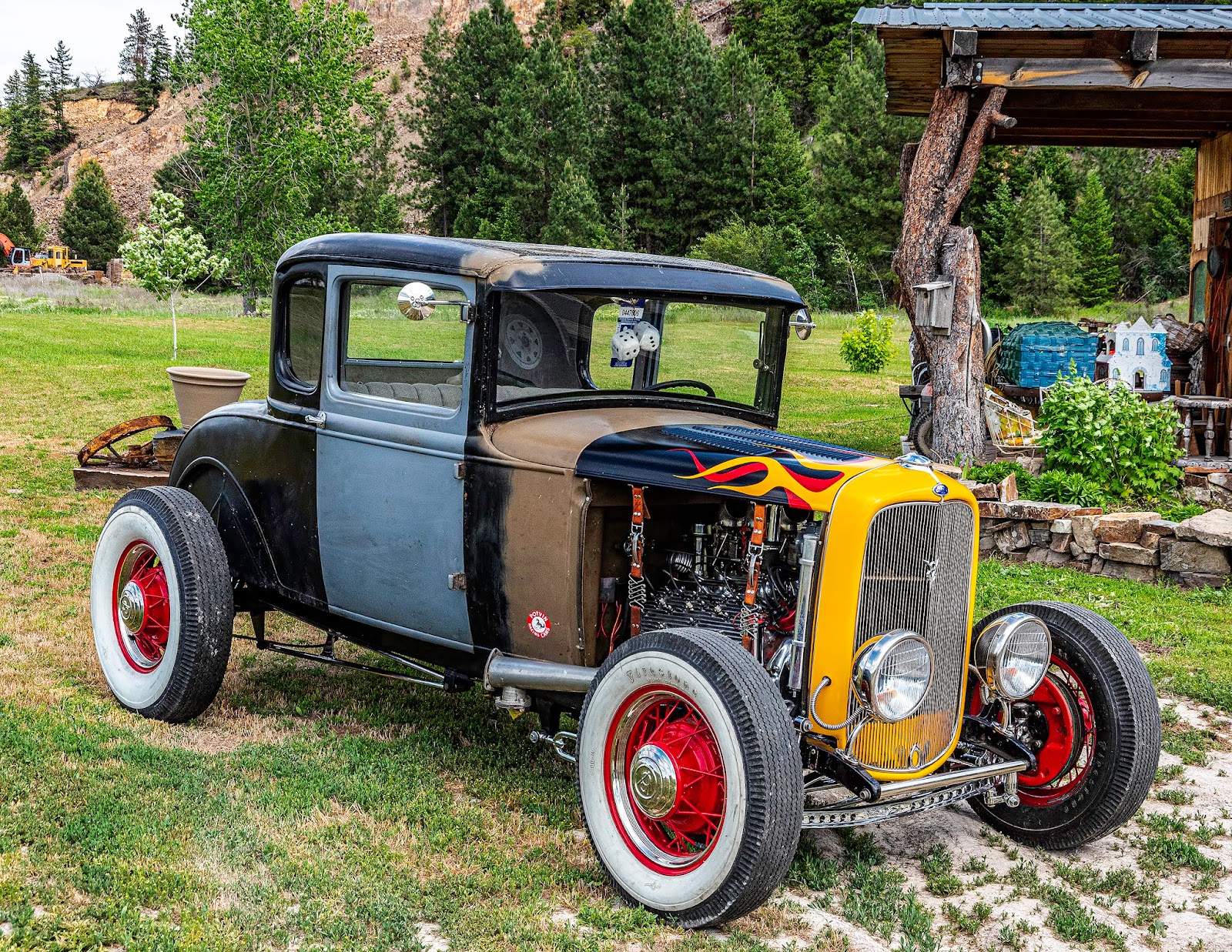
June brought car show season to Plains, starting with the Rehbein Ford sponsored Plains Day Car Show on June 1st.  I took a raft of photos, but missed a few and had to look up the owners.  One such, who wishes to remain nameless, actually took me for a ride in his hot rod.  In exchange, I gave him a portfolio of photos I took of his car.  What a hoot!


June also gave me the chance to work on my photoshop skills by isolating this gorgeous white iris growing in our garden.  I do love my flowers.


That's enough for now.  You've seen what the first half of 2019 threw at us.  Looking back through the photos, it would appear that we did a lot more than I remember.  Guess that's why I take the photos

Second half the year to come.  Stay tuned.  Don't touch that dial!  (Does anyone today rememger a "dial"?

Love,

Bryan, for Kevin, Rocky, Digger and the Cat.


Wednesday, December 11, 2019

Instant Pot™ Cock-a-leekie Soup

Bryan's Instant Pot™ Cock-A-Leekie Soup

 Two days ago, Kevin roasted a small chicken in the oven.  It was delicious, but even though it was very small, there was still leftover chicken.  I could have made a salad, but we are living with soup weather, and since I had a portion of a leek left over as well, I thought, "Why not make Cock-a-Leekie Soup?"  Now understand, I have never made this particular soup before, so I wasn't sure just what to expect, but chicken soup is good, right?  And I like leeks, so what could go wrong?  As it turns out, nothing.

I wanted to make the soup in the Instant Pot™, so I looked up a recipe on line, just to be safe.  If you want to try the original recipe, you can find it here on eatathomecooks.com  If you'd like to try my Yes I Used Leftovers recipe, here it is.  Now I don't know about you, but if I'm going to be eating delicious home-made soup, I want some equally delicious home-made bread to go with it.  In this case, I made baguettes following Dan Leader's recipe for 4-Hour Baguettes.  I've made this recipe several times, and it's never failed me.  Rather than type it out, I'll just send you to the on line site where I found it, Food52.com.  You may have to sign up for a Food52 membership, but it's free and well worth the time.


One and a quarter baguettes
RECIPE:

Bryan's Instant Pot™ Cock-A-Leekie Soup

Prep time:  5 minutes, depending on what you have in the fridge

Pressure Cooker Time:  15 minutes under pressure, plus 12 minutes release time (and of course, however much time it takes your pressure cooker to come up to pressure).

Servings:  I don't know.  How hungry are you?  Are you one of those people who think that 1 pint of Ben and Jerry's is a single serving?  The original recipe claims that it serves 8.  I eat more than they do.

Ingredients:


  • Left over shredded chicken ( I had about 2 cups)
  • 1 1/2 leeks, chopped  and cleaned
  • 5 carrots, pared and chopped
  • 1/3 cup pearl barley
  • dash onion powder
  • 1 bay leaf
  • dash of dried thyme
  • 2 quarts chicken broth (I used Better Than Bouillon mixed in hot water)
  • Salt and Pepper to taste (I forgot to add this, but Kevin added it after cooking)
  • Dried prunes, diced, for topping, optional
Instructions:

  1. Place chicken in the Instant Pot™
  2. Add leeks, carrots, barley,  herbs and spices to the pot.
  3. Pour broth over all ingredients and stir to make sure the Better Than Bouillon is well mixed.
  4. Set Pressure Cooker for 15 minutes.  When time is up, let it release pressure naturally for 10 minutes, the turn the valve to release remaining pressure.
  5. Remove lid and serve, adding the diced prunes if desired.
Now Kevin thought the prunes would not be a good idea, so he didn't add any.  I, on the other hand, wanted to check out just what they flavor they might add, so I chopped up about 5 small prunes and added that into my bowl.  Near as I could tell, they added a very small amount of sweetness to the soup, and I will add them again when I have the left over soup for lunch.

The baguette recipe, by the way, makes three nice sized baguettes, and at this point (10 am the next day), we have only one baguette left.  That's right, between Kevin and me, for supper last night and breakfast this morning, we already ate two of the baguettes.  Your mileage my vary.

And while I'm crowing (cock-a-leekie, get it?), let me tell you I just got the notification that one of my photographs has been chosen to appear in the January/February issue of Montana Outdoors, the magazine published by the State of Montana's Department of Fish Wildlife and Parks.  The picture they chose is shown below, and you can get your own copy of it by visiting my on-line sales gallery by clicking here at RedBubble.  I have chosen to show it as a Metal Print, but you can have it in any of a number of forms, including a mini-skirt, a clock, coffee mugs, or even a bath mat and shower curtain.  Just check out RedBubble.   And the photo itself?  One of my all-time favorite photographs, one that I took at South Sandstone Reservoir, south of Plevna in Fallon County, Montana, back in 2007.

South Sandstone Reservoir, Fallon County, Montana

Saturday, December 7, 2019

Instant Pot™ Potage St. Germain

It's December, and while technically it might not be Winter, the air is cool enough, and there is snow and ice around, so let's make soup.  One of my all-time favorite soups is Potage St. Germain, a French pea soup that I first met through the three volume Illustrated Good Housekeeping Encyclopedic Cookbook © 1965 where I found the recipe in volume 3 page 1190.  I've been making this soup for a very long time, always faithfully following the recipe and always loving the result.  But I have a new kitchen gadget (those of you who know me personally know I belong to the Kitchen Gadget of the Month Club), and frankly, I'm in love with my Instant Pot™.  I've had it just about a year now--it was Kevin's Christmas present to me in 2018, and I'm learning all kinds of new tricks with it.  Two days ago, for instance, I made a risotta in it.  Heaven.  No standing at the stove stirring for half an hour.

Anyway...  When I made the soup earlier in the week, I photographed a bowl and posted that on Facebook and Twitter where friends asked for the recipe.  Since I adapted the Good Housekeeping recipe for the Instant Pot™, here, to the best of my recollection, is what I did (and I have the Good Housekeeping recipe right in front of me as I write this).

Instant Pot™ Potage St. Germain


1 Tablespoon butter
1 medium onion, minced
1 medium carrot, pared and finely diced
The green part of a large leek, chopped or snipped
6 or so cups chicken  or vegetable broth
1 ham hock with some meat attached
1 cup shredded lettuce (or spinach--I used lettuce)
1 bay leaf
A few sprigs of fresh thyme (or a pinch dried thyme)
2 cups quick-cooking green split peas
Salt to taste
1 teaspoon sugar
2 Tablespoons Butter
1/2 cup heavy cream
1 cup shelled fresh or frozen peas (I used frozen)

--------------------------------------------------------------------------------------------------------------------------
1)  Set Instant Pot™ to Sauté and let heat up.
2) Melt the 1 Tablespoon butter in the hot pot, then add in the onion, carrot and leek.  Sauté for 3-4 minutes until the onion is translucent and the carrot and leek has softened.
3) Pour in the stock, add the shredded lettuce, the bay leaf, the thyme, the 2 cups split peas,  the ham hock, salt (and I add fresh ground pepper), and the sugar.  Close top and set vent switch to pressure.   Set the Instant Pot™ to High Pressure and set timer for 7 minutes.  WAIT (It will take approximately 10 minutes for the pot to come up to pressure.)
4) When the Instant Pot™'s timer has counted down the 7 minutes, let the pressure release naturally for 5 minutes, then move the vent switch to release any remaining pressure.
5) When you remove the lid,  remove the bone and if you wish you may use an immersion blender to blend all those veggies, but I don't.  I find the pressure cooking does a pretty good job of mixing everything up.
6) While the soup is still hot, add the frozen peas, the 2 Tablespoons of butter, and the heavy cream.   By adding the frozen peas at the end, the heat of the soup will thaw the frozen peas, but without the pressure, they will remain whole and bright green.  Stir to blend and serve with a good homemade bread.
7)  Enjoy!

Monday, June 18, 2018

Father’s Day, 2018


Panorama of the Bitterroot Mountains
Taken approximately 1,000 feet above Lookout Pass
Montana/Idaho State Line
June 17th, 2018

Yesterday, in honor of Father's Day (or just to get out of the house), Kevin and I took a 200-mile drive around western Montana and northern Idaho. I say it was in honor of Father's Day because the standing joke in our family was that my father would drive to Powell (Wyoming) by way of Cody (Wyoming). For those of you who don't know this region, you can easily drive a pretty straight line from Billings, Montana to Powell, Wyoming, but Father would head west to Livingston, Montana, then south through Yellowstone Park, and finally east to Cody, eventually ending up in Powell. This turned an 88-mile drive into one covering 326 miles and taking at least 7 hours.

 The first of many tunnels
(Northern Pacific Railroad Grade)
Near Lookout Pass, Mineral County, Montana
June 17th, 2018

Honaker Creek
Mineral County, Montana
June 17th, 2018


A Honaker Creek Tributary
Near Bullion Pass, Mineral County, Montana
June 17th, 2018

 We started out yesterday driving to Thompson Falls, then climbed up Clarks Peak to check on Kevin's ham repeater station, then on across the mountains to DeBorgia, Montana where we caught the Interstate to head toward Lookout Pass on the Montana/Idaho border to check on some other radio transmission sites and where I picked up another geocache (with Kevin's help). While there, I noticed a road I didn't know that headed almost due south from I-90 to the Idaho line from a place noted on the map as "Tammany." I'm not sure what Tammany is or was, but it has no physical presence today and certainly no off-ramp from I-90. We drove the back way (part old US 10 and part old Northern Pacific right of way) to just east of the first rest area in Montana, and then back west to a point where the road made a 90 degree turn south and headed up the mountains along Honaker Creek. Again, for those who don't know this area, there is a locally well-known route across the mountains going from Taft (I-90 exit 5) up to the East Portal of the Hiawatha Trail, then over St. Paul Pass into Idaho, but the Honaker Creek road is roughly half-way between Taft and Lookout Pass. The Montana side was beautiful, and I got lots of photos of Honaker Creek and its tributaries. Then we came across something absolutely surreal. You all know those huge metal high-tension power "poles" that look like a giant metal man? Imagine coming up on one of those at the top, instead of seeing it from ground level. The thing is incredibly large at the "shoulders," and that's what you see as you approach the Idaho line on Honacker Creek Road. Of course, I had to take a picture, as well as another picture of the next "pole" (I don't know what else to call them) with swirling gray clouds behind it. It looked like a scene from a terrifying 1950s sci-fi movie. The aliens have landed and they're not happy.


 Man, those things are big when they're at eye level
Near Bullion Pass, Mineral County, Montana
June 17th, 2018
(Note the very dirty windshield)

Run, Run For Your Life!
Near Bullion Pass, Mineral County, Montana
June 17th, 2018


We crossed into Idaho and the road deteriorated drastically. On the Idaho side, the road is called the Bullion Creek Road, or Forest Road 507. We drove slowly down the mountain (maybe 5 mph), dodging rocks and in two places fording streams that had overflowed their banks and were in the process of washing away the road. By this time, the geocaching app on my cell phone had given up, showing us only a gray square where we should see roads--no cell service, don't ya know--and my Garmin Montana 650t was showing us lots of contour lines, but I had no sense of scale so I couldn't tell Kevin how much more of this torture we were due for.  25 miles isn't very far in today's world--but when you're driving at 5 miles per hour....
Southern End of Bullion Creek Road
Shoshone County, Idaho
June 17th, 2018


Eventually we came to a Yield sign nailed to the side of a tall pine (another photo op), and signs pointing north to Wallace, Idaho (17 miles) or south to Avery (11 miles). We turned south and soon found ourselves at a four-way junction with no direction signs that were at all helpful. (Yes, there were signs. No, none of them mentioned Avery at all.) Continuing on toward Pearson, the western terminus of the Hiawatha Trail, we soon found ourselves driving on the Milwaukee railbed for the ten miles from Pearson to Avery with only this "comforting" sign to guide us. "One lane road with passing points next 10 miles." What the sign didn't warn us was that the one lane road passed through several railroad tunnels, some of which were so long that you couldn’t see one end from the beginning. With no light at the end of the tunnel, it was quite possible to get caught inside a tunnel facing oncoming traffic and one or the other of you would have to back up. Fortunately, that did not happen. Not only did we drive through tunnels, but also crossed a couple of railroad trestles, including one across the North Fork of the St. Joe River. I will say this, as we were on a railroad bed, the grade was very gradual, and Idaho (or Shoshone County) has done an admirable job of keeping the road up. After almost 10 miles, we went around a bend and saw a garbage dump right on the side of the road. Strikingly ugly in an otherwise pristine landscape. Around the next bend we found Avery.

Back in the day, Avery was a bustling railroad town, the point where the Milwaukee switched from electric power used through the Rocky Mountains to coal or later diesel for the trek west toward Seattle, with a round house and all the accompanying shops.  Today, Avery is a wide spot on Forest Highway 50 populated mostly by vacationing families living in travel trailers or rental units.  The Avery Post Office is located in the old Milwaukee Depot and there is a gift shop and a convenience store that serves “fast food,” including deli sandwiches, hot dogs, burgers and even fish and chips if you’re brave enough.  I wasn’t, so we stuck to burgers (cheese burger for me) and fries.  The burgers were ok—better than a lot I’ve had, but the fries were terrific.  If you find yourself in Avery, you gotta try Scheffy’s.  Seriously, it’s the only place in town to eat.  The ONLY place in town.

The Kyle Tunnel (#33), Milwaukee Railroad Bed
Shoshone County, Idaho
June 17th, 2018


Forest Highway 50 is one of those roads to nowhere that makes no sense in today’s cost-conscious world.  Its western terminus is at Idaho Highway 3 just outside St. Maries in Benewah County, and its eastern terminus is the Montana state line 16 miles south of St. Regis.  In its 89-mile length, it passes through Calder (unincorporated) and Avery (also unincorporated) and nothing else.  Yet, for some unknown (to me) reason, it is a beautifully paved road, well maintained, that follows the St. Joe River and is now known as the St. Joe River Scenic Byway.    For my money, it’s one of the most beautiful drives in our part of the country and I highly recommend it.  This was Kevin’s first time on the road and he was suitably impressed.  Of course, when you reach the state line, the pavement ends and you have a dirt road most of the rest of the way to St. Regis.  I will say this, the dirt road was easily two lanes wide and very smooth.  The best dirt road we had today by a long shot.  By the time we hit the state line, it was getting late, and I took no more photos nor did we stop to find more geocaches as we were both ready to get home.  All in all a lovely day out in the beautiful Pacific Northwest.
The Saint Joe River
Shoshone County, Idaho
June 17th, 2018

Friday, March 2, 2018

A Dream

Looking at the clock when I awoke, I saw the numbers 4:5, but not the third number.  I'm guessing it was a 7 or an 8 because when I actually sat up the clock showed 5:01.  I had just come out of a dream that really spoke to me, and I hope will speak to you as well, so I'm recounting it here while I still remember it.

The dream began with a call from a close friend who was facing the task of cleaning up the kitchen after a gallery show somewhere.  I'm not sure if she was in an art museum or a sales gallery that had hosted an First Friday type event, but that wasn't important.  What was important is that the kitchen needed cleaning, specifically the oven where something had run over and burnt onto the floor of the unit. My friend, Cathy, was quite upset, and I did what I could to calm her, including taking apart the oven and letting the pieces soak overnight.  Everything would look better in the morning.

The next morning a group gathered at Cathy's house, men and women of roughly the same age, 25-30, some parents, some not.  We were standing around her kitchen counter and talking about the task at hand.  Somehow, in the manner of dreams, we no longer seemed to be as concerned with the cleaning of the kitchen and talk turned to introducing children to art.  Cathy had a medium sized screen with various images and e-books, and was going through them as she talked.  She opened one image, and quickly closed it back down.  I was standing across the counter from her, and noticed only the image of a Devil's Tower shaped formation, or possibly it was something from southern Utah or eastern Arizona--you know the type of red rock formation I'm talking about.

Watch for (Red) Rocks
Sedona, Arizona
Dec. 3rd, 2010

The picture was a cover photo of a book and there was text as well of which all I could read was the title, The West.   As I said above, Cathy had no sooner opened the image on the screen than she set it down.  I spoke up.  As we were talking about introducing children to art, and their reactions to that, I felt it important to point out that we needed to make sure that children understand that our words might not mean the same thing in different contexts.  As an example, I chose to talk about the meaning of "The West."  Mind you, I have no children, have never had children, and was very clear about that.  But inside my 25 year old head (and in my head and heart, I am 25--I have no idea who that 68 year old man is who looks back at me from the mirror), I could remember being a little boy, growing up in Montana.  And to this little boy, I pointed out, "The West" meant cowboys and indians.  What will a child think if we talk about the West, and instead of showing him action, we show him rocks?  The first example that came to my mind was a photo I took near Perma, Montana that I named "Iconic Montana."  It is a scene of a group of horses caught running across a hillside on the Flathead Indian Reservation.   It seemed to me, that as a young boy, this image would much more likely jump to the fore as an image of "The West."

Iconic Montana
Perma, Montana
April 15th, 2013

No cowboys or indians, but how can you have either without horses?  But not more than a couple miles away I had taken another picture that surely could be considered "iconic Montana."  This picture, captured just east of mile marker 102 on Montana Highway 200 shows the Flathead River in the foreground and the Mission Mountains, covered in snow in the back.  I grew up knowing that one of the nicknames for Montana is "The Land of Shining Mountains," and even before I knew that "Montana" is the Spanish word for mountain, I knew that the native people had used "shining mountains" to describe my homeland.  Still, it seemed to me that this image would appeal to adults more than to children.

The Flathead at Mile 102
Perma, Montana
April 22nd, 2017

Another image came to mind as we discussed the topic, one that I had captured roughly fifteen miles east of the first two.  This image, which I have named "Montana Amish," was taken at the Amish owned Mission General Store at St. Ignatius, Montana.  And while most people probably don't think of the Amish as typically Montana, a horse and buggy tied to a hitching rail, certainly conjures up life from the 1800s, doesn't it?  Couldn't this image as well signify "The West"?

Montana Amish
St. Ignatius, Montana
March 11th, 2014

As I thought about the three images, I suggested that, at least for a boy, the scene with the horses would probably come first, the buggy second, and the mountains third in any discussion of how do we envision "The West."  My guess is that a young girl would probably put things in the same order, while an adult might well choose the mountain image first.    I'm open to anyone trying to change my mind on that.

Just before I woke up, I thought of a fourth image (I'm ignoring Sedona for now).  One that I think would capture a young boy's imagination even more than the running horses.  Definitely a scene from "The West," this photograph screams, to me at least, "look where we are now!"  I took this photograph during the Homesteaders' Day parade in the small town of Hot Springs, Montana, in 2013. but I've seen the same parade entry in other years.  

The Modern Indian
Hot Springs, Montana
June 9th, 2013

Again, ignoring the original scene from Sedona, Arizona, the rest of the pictures were all taken within a 25 mile radius, all in Montana, all on the Flathead Indian Reservation, and, to my mind at least, all signify "The West."  And at that point, I awoke.