Showing posts with label Amtrak. Show all posts

Thursday, February 23, 2017

Alabama: The Heart of Dixie

Welcome Sign, Interstate 59, Georgia/Alabama Line
September 2nd, 2012

To date, I’ve been to Alabama twice.  First time was back in 1999, when I attended a three-day conference in Birmingham with New Image, International.  The Conference was held at the Birmingham-Jefferson Convention Complex, an easy walk from our hotel which was located right in the heart of the city, and only a few blocks from the Amtrak station where I arrived on the Southern Crescent from New Orleans.  It was an easy walk until the police closed off the street that connected hotel and convention center, which they did because the Ku Klux Klan was having a major demonstration half-way between the two venues in “honor” of the Martin Luther King holiday.  1999 was seven years before I got a decent digital camera, and while I know I have photographs from that trip, at present I’m having trouble locating either the prints or the negatives to scan.  Oh well, you’ll just have to imagine what that trip was like from my words.

Inside our Cabin at Bluff Creek Falls
Steele, Alabama
September 3rd, 2012

Riding the Southern Crescent, we pulled out of New Orleans, crossed into Mississippi shortly thereafter, and crossed that state in a diagonal line from Southwest to Northeast, a trip I’ll discuss in my post about Mississippi.  The Crescent runs between New York City and New Orleans, and the Amtrak guide assumes that you will be heading south and gives all the miles as distance from New York’s Penn Station, the busiest rail station in the country.  The total travel distance is 1,377 miles, and you cross the Alabama/Mississippi state line at mile 1,155, or 222 miles from N’Awlins.  Once you cross into Alabama, the rail line runs roughly parallel to and south of Interstate 20.  You pass through the towns of Livingston and Eutaw, cross the Tennessee-Tombigbee Waterway, and stop in Tuscaloosa, home of the Crimson Tide and all things University of Alabama.  After several hours and 354 miles, you arrive in Birmingham, Alabama’s largest city located toward the southern end of the Appalachian Mountains, and therefore quite hilly.   I have to admit that I have no memory of the Alabama portion of the trip, at least not until I stepped off the train at the Birmingham Station, which struck me as old, pretty small for a big city train station, and located in a not very interesting neighborhood.  For those who don’t know the city, as well as being the largest in Alabama, it is the 103rd largest city in the U.S., with a 2010 Census count of 212,237, down from 242,840 in 2000, one year after I visited.  In fact, the population of the city has declined in every census since 1960 when the count was 340,887, the highest ever for the city.  In other words, over the past fifty years, the city has lost a third of its population, although the 2015 estimate showed a minimal increase from 2010. 

Parked Outside our Cabin at Bluff Creek Falls
Steele, Alabama
September 3rd, 2012

This decrease became apparent my first evening in town.  Despite being in the center of an apparently prosperous downtown, judging solely by the new skyscrapers that surrounded our hotel, there were no restaurants open after 5 p.m., and no retail businesses to speak of any where we looked.  Oh there were lots of empty storefronts on streets nearby, but most looked as if they had been closed for years, or even decades.  A local explained to me that downtown historically was the Negro section of town, and with increased prosperity and desegregation, the Blacks had moved to the suburbs and no one had taken their place.  It gave downtown Birmingham a distinct ghost town feel, especially after the skyscrapers emptied of their white-collar workers.  Missoula friends attending the same conference, had a rental car, so we were able to get out of downtown and see a bit of the city, albeit by night, including the section called Five Points South where we found restaurants and the hill on top of which Vulcan, the largest cast-iron statue in the world, looks over the city and moons the suburbs.  (Well at least in 1999, when I saw the statue.  At that time, Vulcan wore an apron which protected his family jewels from the heat of the forge, but his apron was open at the back, and his cheeks were quite visible should you approach him from the rear.  I understand the statue has been completely renovated since then, so I cannot say what he is showing the world today.) 

The Pool Area at Bluff Creek Falls
Steele, Alabama
September 3rd, 2012

I never saw the hooded Knights as the police diverted all traffic away from the area, but I remember the next day walking a couple of blocks from our hotel to visit a park dedicated to the Civil Rights struggle.  Unfortunately, while I know I took photographs on this trip, including several from the train and in Birmingham itself, I cannot find those images.  Nor do I have any memory of returning to the Amtrak station, boarding the train or the return trip to New Orleans.

Yes, George Wallace's wife has a street named for her
Tuscaloosa, Alabama
September 3rd, 2012

My second trip across Alabama was in September, 2012, when Kevin and I drove from Columbus, Ohio to Starkville, Mississippi, and spent a night outside of Steele, Alabama en route.  On this trip, we entered Alabama from Georgia on Interstate 59, capturing the Welcome sign shown at the head of this post.  We stopped for supper in Gadsden, then proceeded on to Steele where we stayed in a cabin at Bluff Creek Falls.  We had been driving through torrential rains as we skirted the path of Hurricane Isaac, and the grounds at Bluff Creek were drenched.  As a result, we spent no time in what looked to be a lovely pool, were the weather better, but the friendliness and hospitality of the hosts and campers were unmatched and we had a very pleasant evening there, albeit inside.


US Highway 82, Western Alabama
September 3rd, 2012

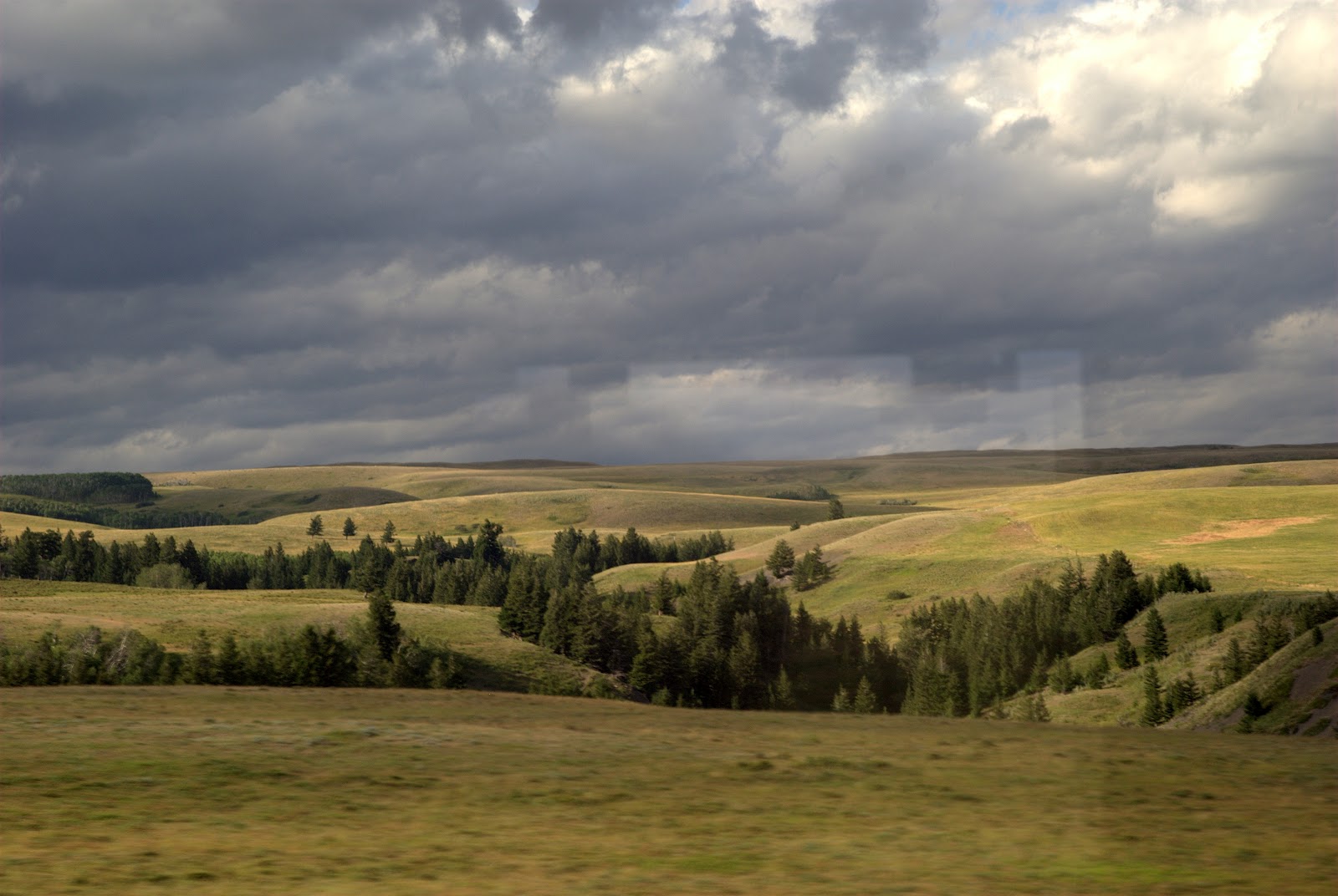
The next morning, we reloaded the Saab and headed on through Birmingham, Tuscaloosa, where Kevin had his very first Waffle House experience and got a Waffle House cap for being a “virgin,” and then on across western Alabama on U.S. 82, crossing into Mississippi just east of the town of Columbus.  All of the pictures accompanying this post are from the 2012 drive.

Saturday, August 11, 2012

The Second Sunday Drive, Day Three

The Welcome to Wisconsin Sign
(as I'm leaving the state from Marinette, WI)


My cell phone alarm rang at 7:30, followed almost immediately by the wake up call I had requested when I checked in.  I almost never need an alarm, but this morning was an exception.  I’d been in bed for barely four hours, after two days with little sleep.  Nels Nelson from Joe Van Horn Chevrolet was picking me up at 9, and I wanted to be dressed and have breakfast before he arrived.

The shower helped a bit in reviving me, and I went downstairs to the hotel’s restaurant for breakfast.  The waitress offered me a menu, saying that they did have an all-you-can-eat breakfast buffet.  Rather than try to unblur my eyes to read a menu, I headed for the buffet.  Two burly gents entered the room, one immediately accosting the waitress with “What have you done with my friends?”  Eventually the two were joined by three more fellows, one of whom was wearing a “Harley Davidson – Dubai – UAE” t-shirt.  I had passed a group of bikes by the front door when I got to the hotel, and I assumed, correctly as it turns out, that the bikes and these fellows were connected.  I had a chance to talk with one at the buffet line, and learned that they were from, not Dubai, but South Africa.  They were in Milwaukee, home of Harley Davidson, on their way to Sturgis, South Dakota.  I’m going to assume that my readers all know about Sturgis.  If not, Google it.


First Photo Op with the new Saab

After breakfast, I carried my bags downtown to await Nels’ arrival.  This would be it.  Now I would know if I had bought a car or given mucho dinero to a scam artist.  I bought a car.  Nels arrived right when he said he would, and helped me get my bags into the trunk of the Chevrolet he was driving.  On the way north to Plymouth, we talked about many things, including the importance of cheese to the Wisconsin economy—particularly to the Plymouth, Wisconsin economy.  Sargento, Borden’s, and several other cheese processors are all located in Plymouth.  Johnsonville—the sausage maker—is also in that area.  Nels and I talked about Scandinavian naming traditions (he was named for his grandfather, as is typical in his community).  We talked about our parents’ experiences in the 40s.  I’m not sure if there’s anything we didn’t talk about.

When he pulled into the dealership’s lot, he told me that the salesman would want to show me my car, but he was going to take me there first.  After allowing me to walk around it, he herded me into the showroom, not allowing me to actually get in the car, or even open a door.

A Scenic Overlook--looking out toward Lake Michigan

I don’t believe “showroom” is the right word for car dealerships these days.  There were no cars to show.  Just desks with computers.  It was a sales room, not a show room.  The sales manager, Rodney, greeted me (we’d spoken on the phone several times as my train was delayed), and introduced me to the salesman who would be helping me finalize the deal.  The salesman and I went for a test drive, and discussed the importance of golf to the Plymouth economy.  Well, he discussed it.  I maintain that golf is a practical joke the Scots played on the rest of the world, and the world never caught on that this was a joke.  We also talked art.  Plymouth is in Sheboygan County, and Sheboygan is home to the Kohler Art Museum where Nancy Fields O’Connor and I had arranged for an exhibit of her grandfather’s early twentieth-century photographs of the Crow Indian Nation.  And finally, we talked cheese and brats.  If there was any doubt before, I couldn’t ignore the fact that I was in Wisconsin, America’s Dairyland.

Once back to the salesroom, I was asked to wait in the reception area while the sales crew dealt with another customer.  While I waited, a rather elegant looking woman came in and sat down next to me.  We didn’t converse, though, until Nels burst into the room saying, “I knew I enjoyed our conversation, but I didn’t know I was talking with someone famous.”  I had no idea what he was talking about, but the woman next to me asked, “Famous?  Who is he?”  Nels replied, “He’s a photographer.”  Apparently, for some reason, Nels had seen fit to Google me and had found some of my on-line photographic galleries.  Thank God.  There’s so much more he could have found.

After pumping my hand and telling me how much he enjoyed meeting me, Nels left, and the woman and I chatted.  She lives in Miami, and each summer spends three months on the road with her children.  When she learned that I live in Missoula, she told me about her experiences staying at Paws Up, the former Lindbergh Ranch purchased by Charles Lindbergh after he put the Spirit of Saint Louis in the hangar for the last time. 

The Menominee County Court House, Menominee, Michigan

While we were talking, the salesman came in to tell me he was ready for me.  We filled out all the proper papers, discussed the details of the transaction, and he handed me my keys.  I had, indeed, just bought a car, on-line, and several states away from home.  What a brave new world we live in.

The dealership sits next door to Wal-Mart, where I stopped and bought an electric cooler I could plug into the car’s power point.  Having fillled said cooler with Peace Tea, Naked Mango smoothie, veggies, lunch meat and, yes, cheese, I set the car’s Navigation System to Marinette, Wisconsin, and headed northeast.  Marinette is on Lake Michigan, north of Green Bay, and right on the state line.  You cross from Marinette WI to Menominee MI, not by turning the first letter of the state’s name upside down, but via a bridge.  I crossed the bridge three times in order to get the pictures I wanted. 

At Menominee,  I set the Nav System to get me to Mackinac City, but by the time I reached Escanaba, I knew it was time to get off the road.  Checking into the Super 8, I asked the very friendly desk clerk to recommend a restaurant that would be good and fun.  He questioned me on “fun,” but I didn’t back down so he directed me to the Hudson Grill.  Indeed, as I sat eating my fish and chips (which fit my criteria of “good”), I stared into the grill, in fact the entire front end, of a 1952 Hudson.  Definitely “fun.”
Back at the motel, I checked out the pool/spa, but finding it full of screaming children, decided that it would be more relaxing to return to my room and chill.  And that’s what I did, thus ending Day 3.

Sand Point Lighthouse, Escanaba MI

Thursday, August 9, 2012

The Second Sunday Drive, Day Two

North Dakota Ghost Town at Dawn

Прощай, Москва

I had no idea there were so many different songs that say Goodbye to Moscow, but to hear the one I try to quote below, sung by Vera Smirnova, click on this youtube link.


As the train pulled out of the Glasgow Montana station, I overheard people grumbling about being ten hours behind schedule.  Apparently we not only hadn’t made up any of the lost time, but we were falling further behind.  Quite a few people boarded at Glasgow, including a very angry father with four tow-headed boys and a very pregnant wife.  The boys were the epitome of stair-step children.  I’m sure father had reached the end of his rope trying to keep everyone calm during the extended delay.

I tried pretending to be asleep, but that did not keep the conductor from shining his flashlight in my face and telling me that I had to move.  He placed me in the aisle seat in the row ahead of where I had begun the trip, sharing the seat with a man who wasn’t pretending.  He was sound asleep.  Earlier I had heard him talking with his seatmate, a man who had taken advantage of the opportunity to change seats after space opened up in Havre.  (At Glasgow, the conductor moved him, too.)  My new seatmate I understood to be Russian with a very limited English vocabulary.

The sky lightened as we crossed North Dakota.  The scenery outside our windows showed the results of much of the same depopulation as I had noted in eastern Montana.  It also showed small fires burning in the oil fields.  Instead of fires at the tops of exhaust pipes, as I was used to seeing, these fires were at or near ground level.  I overheard many passengers commenting on the ubiquitous flames.

As we stopped at a siding between Williston and Minot, I noticed a castle turret out the side window.  Even though the light was barely suitable for photography, I grabbed my camera to record the scene.  At one time, this ghost town had a very elaborate church whose square, crenelated tower rose above the abandoned buildings surrounding it.

Overgrown and abandoned North Dakota Farm

When the dining car personnel  announced breakfast, I didn’t hesitate to get in line.  Having missed dinner the night before, I was not about to miss breakfast.  Neither breakfast nor lunch required reservations.  Seating was on a strict first come, first served basis.  The waiter placed me at a table with two women, mother and daughter, and a young man then joined us.  The women were from the South, and the young man from New Orleans.  All had traveled extensively.  In this company, I found it amusing that I was the only person at our table to order grits instead of hash browns.  I also ordered a Denver omelet and a glass of orange juice.  The food was good, but not as tasty or as attractively presented as I recalled from my trip on this same train back in 1999.  

I was beginning to get an idea of what had happened to our train.  Should you go to Amtrak.com and look for the Empire Builder, you will find that it is listed as both train 8 and train 28.  I wasn’t sure what the difference was, but it turns out that train 8 leaves from Seattle while train 28 leaves from Portland.  They meet and merge at Spokane, and from that point on are essentially one train with two different numbers.  The young man at our breakfast table had left from Portland where the tracks were blocked by a rock slide.  Amtrak put the east-bound passengers on a bus and took them to Spokane.  At the same time, apparently a computer glitch caused a switch to open in the Seattle yard, and the east-bound train   number 8 derailed.  After determining that there was no equipment available in Seattle capable of lifting the Amtrak engine back onto the track, the company put the Seattle boarding passengers a bus as well, taking them to Spokane.  The time it took to make the decision to bus passengers instead of repairing the problem was the beginning of our delay.  (Why does it always seem to take the powers that be so much time to make what should be an immediate decision?  The tracks are blocked—by rocks or by a derailed locomotive, and we have passengers to move, so put them on a bus.  What’s hard about that?)  The next problem, adding to the delay, was that without either train 8 or 28 arriving in Spokane, there was no train on which to put the passengers arriving by bus.  They had to wait at the Spokane depot for the west bound Empire Builder to arrive and be turned around.  I presume that the west bound passengers were all bussed from Spokane on to their final destination, but that is an assumption on my part.  

Another North Dakota Ghost Town
Rock slides, derailments and the need to wait for a train to arrive explained why so many of us waited for eight hours at Whitefish, but why was the train falling further behind?  The daughter at our breakfast table had an explanation for that.  She had been told that according to the agreement Amtrak has with the commercial freight lines over whose tracks Amtrak runs, passenger trains take priority as long as they are less than two hours behind schedule.  Once they pass that magic limit, they have to sit on the siding while any approaching freight train passes by.  I take it as an encouraging sign that there are so many freight trains running these days, but we did seem to spend a lot of time sitting on sidings.  At one point in central North Dakota, the conductor made the announcement that we would be sitting still for the next fifteen minutes while freight trains passed.

Back at my seat, I found my seat mate awake and tried to converse with him.  As I mentioned above, his English was very limited—but not so limited as my Russian.  I can say “da,” “nyet,” and “dosvedanya,” but that’s about it.  There was one thing more, however.  Back in grad school I would join a group of Slavic language students who met outside Wheeler Hall every Friday afternoon to play guitars and sing folk songs, most of them in Russian.  I have an amazing memory for song lyrics, and so I started singing Russian folk songs to my seat mate.  He smiled, and joined in with some of them.  At that point, I had an urge to channel my inner Julie Andrews and get the whole train singing Russian folk songs as a way to get them over their grumbling.

Proshai, podrugu dorogaiya.  Proshai du gainskaiya sembya.
Proshai, Proshai, podrugu dorogaiya, Bog znaiet, u vishyu la tembya.

Or something like that.   I know that Proshai means  Good-bye forever, I’m going off to the gulags in Siberia, more or less, as opposed to Dosvedanya which means Good-bye, I’ll see you soon.  And the last phrase means “God knows if we’ll ever meet again.”  (Bog znaiet is God knows.)

North Dakota farm land with reflections through the train window

We crossed the Red River from Fargo to Morehead, crossing from North Dakota into Minnesota.  At some point, I had lunch in the dining car, but I don’t remember exactly where we were at the time.  My seat mates were an older couple from Rochester, New York, and a young woman who didn’t have much to say.  Although we tried to engage her in conversation, she rarely spoke more than a word or two at a time.  The husband of the couple, however, was very gregarious, and he and I talked of many things—“cabbages and kings, shoes and ships and sealing wax and whether pigs have wings.”  Well, maybe we didn’t go that far, but we did discuss the Rochester economy in light of Eastman Kodak’s collapse.  We also discussed travel by train and by ship.  We agreed that travel is always an adventure, and that there was no point in complaining about things like travel delays over which we had no control.

Night was falling by the time we reached Minneapolis, and the rest of my journey was in complete darkness.  I didn’t see any of eastern Minnesota or Wisconsin as we traversed the entire state.  At 3:00 a.m. the train stopped at the Milwaukee station, and I grabbed my bags and left the car I’d been riding in for the last thirty-five hours.  We were now thirteen hours behind schedule.  No one had boarded the train at any station since Minneapolis—at least none that I noticed—and I have to assume that they were so close to the train’s final destination, Chicago, that they found alternative means of transport rather than waiting around for a train that might never arrive.

Stepping out of the station, the air was warm and humid.  For the first time since I boarded the train in Whitefish, I felt warm.  I looked unsuccessfully for a taxi—What???  They don’t hang around the train station at 3 a.m.???  An Amtrak security guard offered to call one, but suggested that it would probably take them over an hour to pick me up.  He asked where I was going, and I told him the Ramada downtown.  He laughed, and asked me to follow him.  After walking to the end of the station, he pointed up the hill toward a red sign.  “Ramada”  My hotel was two blocks away.  I retrieved my checked baggage from the station, and walked to my hotel, where I checked in, got to my room, and slept.

And the evening and the morning was the second day.

A prosperous North Dakota farm

Sunday, August 5, 2012

The Second Sunday Drive, Day One

"Whitefish Rising" by Cody Houston, 
with the Whitefish Montana Rail Station in the background
Whitefish, Montana, 8/2/2012


Starlight Express, Starlight Express
Are you real? Yes or no?
Starlight Express, Answer me yes!
I don't want you to go
 --Music by Andrew Lloyd Webber, Lyrics by Richard Stilgoe
 To hear the original cast singing Starlight Express at the Tony Awards, with some amazing footage from the stage play itself, check out this youtube video.

I've wanted a Saab 9-4x ever since Del McCormick, owner of Dana Motors in Billings, Montana, told me about the last model produced by the Swedish company.  Produced on GM's Theta Epsilon platform, the Swedish engineers created a fantastic car that GM then reverse engineered to come up with the Cadillac SRX.  Both cars were built on the same assembly line in Mexico (yes, a Swedish Mexican American car--sounds about right these days), until GM's reorganization killed off Saab.  Well, the time has come to replace my faithful 2001 Volvo V70, and the one car I wanted more than any other was the Saab.  With Kevin and me in the process of reinventing our lives, I bought me the Saab.  The downside was that the car was being sold by a dealer in Plymouth, Wisconsin, and I would have to get there somehow.  Kevin suggested that while I was at it, I should go on to West Virginia and visit my family there.  Sounds like the beginning of a great road trip, doesn't it.  The Second Sunday Drive (the first being my 6,000 Mile Sunday Drive back in 2007) was about to begin.

Kevin argued for a flight from Spokane to Milwaukee, but I like traveling by train and besides, it didn't feel right to start out a road trip with a flight.   I booked a ticket on Amtrak's Empire Builder, with the intent of riding the train in comfort from Whitefish, Montana to Milwaukee, Wisconsin, where someone from Van Horn Chevrolet would pick me up and take me to my new car.  Sounds good in theory, right?

Amtrak's Empire Builder, Train 8/28, Arriving at Whitefish Montana
August 2, 2012
 

Amtrak originally ran trains across both the old Great Northern tracks along the Canadian border and also along the old Northern Pacific tracks through southern Montana.  Missoula had its own station which would have been very convenient.  These days, only the northern route survives, which meant driving to Whitefish.  For my readers who don't know Montana, Whitefish is 150 miles north of Missoula, which means that on a good day with no traffic you can get there in about 2 1/2 hours. As the train leaves Whitefish at 7:30 or so each morning, Kevin thought it best to drive up Tuesday evening and stay overnight.  Alas, this is tourist season; Whitefish is a resort in its own right and is next door to Glacier National Park, and just north of Flathead Lake, another popular destination.  We couldn't find a motel room in the region under $200, so gave up on that idea.  I set the alarm for 3:00 a.m., and woke Kevin after I had taken my shower.

The drive north was pleasant, and at 5 in the morning, there's little traffic, so we made good time.  Strangely enough, the only restaurant we could find open for breakfast at 6 was in the Whitefish bowling alley.  Arriving at the station at 7, we saw a sign stating that the train was delayed and its E.T.A. was now 1:10 p.m.  For this I got Kevin out of bed at 3:15?  Kissing my man good-bye, I settled in with a good book and let Kevin return home.  (I always carry a good book, as the Highland Scots say, "in case.")

Glacier National Park as seen through the train window
August 2, 2012


After sitting in the depot for four hours, I looked up to find that we had a new E.T.A.--2:40 p.m.  OK, it's time to think about lunch as we won't be getting it on the train.  A fellow traveler and I walked downtown, only to find that the tourists who had filled the motels were now filling the restaurants.  I can't remember the name of the place where we ended up, but I got a wrap and she ordered a sandwich and fries.  Her fries had to come from the restaurant next door, and ended up costing her $4.00--which worked out to about 25 cents per fry when she opened the box and saw how few were included in her order.  Did I mention that Whitefish is a resort town?  It's also one of three towns in Montana which charge a sales tax, so I try to avoid spending any money there if at all possible.

Back to the station in plenty of time for a 2:40 train, only to learn that there was a new E.T.A.  Amtrak was now expecting the train to arrive around 3:15.  A quick calculation told me that if the train was seven hours late getting to Whitefish, it would get to Milwaukee not at 2:00 p.m., but rather at 9:00--after the car dealership had closed for the evening.  Unable to get a good internet connection using my iPhone as a hotspot, I called Kevin and asked him to make me a hotel reservation in downtown Milwaukee.  I suggested the Ramada as it appeared to be close to the depot.  I next called Van Horn Chevrolet and suggested that they pick me up Saturday morning, instead of in the middle of the night on Friday.

Now I don't know about you, but I've never before bought a car on-line.  Throughout the whole process I had been asking myself if I was dealing with a legitimate business or would I get to Milwaukee and find that I had been scammed.  I got a great price on the car, sure, but what if the wire transfer went to some unscrupulous individual pretending to be a car dealer.  Stranger things have happened in the on-line world.  And the way the day has been going so far, can you blame me for being concerned?

East of the mountains, Glacier County, Montana
The Blackfeet Indian Reservation
August 2, 2012

There was a light at the end of the tunnel around 3:45, and sure enough, that light turned out to be an oncoming train--in this case Amtrak's number 8 and 28.  We pulled out of Whitefish around 4 p.m., only 8 1/2 hours behind schedule.  The depot crew assured us that Amtrak would be trying to make up time along the route, but I wasn't sure just where they could do that.

Lots of folk boarded the train in Whitefish, including a group of 10, mostly young men, from near Cincinnati.  Their adult male companions were wearing boy scout uniforms, so I assumed these were a group of scouts who had just been camping in Glacier.  Of course we know about assumptions, and I never asked the guys themselves what they had been doing in Montana.  The last time I rode Amtrak, there was a lot of space to spread out and relax.  This time the train was packed.  I grabbed a seat by the window, and soon was joined by an elderly man who had just been visiting his son in Lakeside, Montana.  He was now returning home to Havre.  Along the way, we had a delightful conversation, and I learned that he is the youngest of three brothers, all still alive.  He himself was only 94.  His brothers are 96 and 101 years young.  Looking at him, I would have guessed his age at 80 at the most.  We talked about everything under the sun, avoiding the two danger topics:  politics and religion.  I was sad to see him de-train (as they call it) at Havre, but now I had the seat to myself.

I never saw the dining car people come through taking names, so when I heard the announcement that the dining car was now open for those with a 5:30 reservation, I asked the conductor how to reserve a seat.  He told me that I would have to ask the dining car folk themselves, and that I'd better hurry.  Long story short, I did not get dinner on Amtrak that evening.  I was put on a waiting list, but my name was never called.  Dinner for me consisted of a hot dog and bag of chips from the lounge car.  OK, I'll not check my blood sugar in the morning.

Evening in Toole County, Montana, with the central peak of the Sweet Grass Hills in the distance
August 2, 2012


The sun set somewhere between Shelby and Havre, and once my seatmate had left the train, I stretched out to try and get some sleep.  I'd been up since 3 a.m. after all.  Two things kept me from sleeping.  With my knee still throbbing from a fall down the stairs over a month ago, it was hard to find a comfortable position.  That combined with the fact that I didn't have a blankie along.  I prepared for the weather to be hot and hotter.  I packed no jacket, no sweatshirt, no long pants, and certainly no blanket.  And even if I had, they would have been in my checked luggage, not my carry-on bags holding the essentials:  camera, computer, and books, books, books.  Amtrak had turned the air-conditioning on high, or even glacial, and I, dressed in shorts, sandals and a short-sleeved shirt, could not get warm.  I quickly noticed that I was the only one not in the know, as everyone else on board was wearing hoodies, jackets, heavy coats even, or was wrapped in a blanket.  Live and learn.

People kept boarding the train at every stop, usually more boarding than getting off, and at Glasgow, two stops east of Havre, the conductor told me that I would have to move because "families have to sit together."  I ended up sitting next to a man sleeping under his blanket, and this seems like a good place to leave things for day one.  Friday's adventures will appear in the next post.