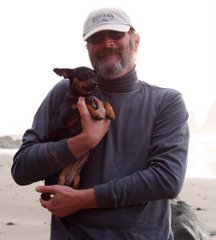
China Beach, Curry County Oregon
December 30th, 2006
Writing an op-ed piece for today’s New York Times, Paul Theroux, one of my favorite American authors talks about how much more crowded America is today than when he was growing up. He notes:
In my lifetime the population has doubled. I’m glad I grew up when the number of Americans was so much smaller. How does one explain to anyone under 50, or to the grateful unfazed immigrant from an overpopulated nation, that this was once a country of enormous silence and ordinariness — empty spaces not just in the Midwest and the rural South but in the outer suburbs of New England, like the one I grew up in, citified on one margin and thinning to woods on the other. That roomier and simpler America shaped me by giving me and others of my generation a love for space and a taste for solitude.
In my lifetime, my beloved Bitterroot Valley in western Montana’s Ravalli County has gone from a largely rural place where there were distinct towns separated by miles of farm land to a 95 mile-long stretch of US Highway 93 where, except for the last 7 miles as you approach the Idaho state line at 7,000’ Lost Trail Pass, you are never out of sight of at least one house. Get off 93, and you’ll find the woods full of homes. A friend who flies his own plane over the valley tells me that I’d be amazed at the number of homes hidden in the back country.
Over the past thirty years, I’ve seen the same type of growth happening in Del Norte and Curry Counties—the north western corner of California and southwestern corner of Oregon. Though not as remarkable as the growth in Montana, what has happened in this remote part of the Pacific coast is truly astonishing. As in Montana, there is no natural reason for the population growth. Neither area has any extensive industry or large business to employ the people moving in. And while according to the highway signs, building Pelican Bay State Prison in the late 1980s tripled the population of Crescent City, Del Norte County’s seat and main population center, the county’s population grew only 28.78% between 1980 and 1990—the largest growth spurt in the past forty years. In fact, the 2000 census showed the county at 27,507, not even 10,000 more than the 1960 census count of 17,771. Curry County Oregon grew from 13,983 in 1960 to 21, 137 in 2000. Both counties had remarkable population decreases in the decade between 1960 and 1970. Ravalli County, Montana, on the other hand, has grown from 12,341 in 1960 to 36,070 in 2000.
I'm led to all of this number crunching by driving home from a deserted Oregon beach. Unlike US 93, US 101 remains a rural highway along this stretch of coast. Towns remain discrete—separated by miles of seemingly empty land. That isolation is, however, deceptive. Get off 101 and again the woods are full of homes. Pretty impressive homes at that, some with electric gates to keep the barbarians at bay. But the beaches are another matter.

Indian Sands, Curry County Oregon
December 29th, 2006
Isolated, definitely not handicapped accessible, beaches like China Beach or the area called Indian Sands can be your own private paradise. Friday found Gypsy and me the only visitors to Indian Sands, and Saturday Carl, Steven, Gypsy and I saw only one other human on China Beach—and he was so far away that it was impossible to make out whether it was a man or woman. In fairness, I did meet two guys from Bakersfield CA in the Indian Sands parking lot and we saw two other guys on the Coastal Trail as we were returning from China Beach.
With no industry as a lure, people move to places like the Bitterroot, or this coastal area, because of the quality of life possible. I, for one, love being able to walk the Oregon Coastal Trail for miles without seeing another soul. I love being able to strip down and sunbathe on a deserted beach (especially on December 30th). Even in Crescent City it’s possible to walk along Pebble Beach or find a spot in Front Street Park to be by yourself, or with a close friend. And so, since it’s Sunday and sunny, I think I’ll go for a stroll.
Happy New Year!

Gypsy and me, China Beach, Curry County, Oregon
December 30th, 2006