Showing posts with label Vocation. Show all posts

Saturday, June 16, 2007

Father's Day, 2007

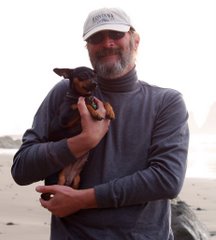
Poppa (Clarence Gilbert Spellman), 8/16/1912-3/20/1988
With Hans (1968-1980)
Taken at the family cabin near Stevensville, Montana
Summer 1973


Faith of our fathers, living still,
In spite of dungeon, fire, and sword,
O how our hearts beat high with joy
When e’er we hear that glorious word!

--Frederick W. Faber, 1849

I never came out to my father. By the time I gained the courage to be honest, my father was no longer mentally competent. Mother tried to explain my living situation the one time my parents visited my partner and me in our Montana home, but neither Mother nor I were ever sure just how much Poppa understood.

Maybe I should get one thing out right in the beginning. I’m a PK. Now you all know what a PK is, don’t you? Poppa was a minister in the United Methodist Church. I’m a Preacher’s Kid, a PK for short. At fifty-seven years of age, I’m ready to accept that fact. It’s taken a while. As a kid, I didn’t think too much about it. It was my life and I lived it.

Growing up I quickly became aware that I was not the son my father wanted. My parents had been married for fifteen years when I was born. They had lost two children, boys both, at birth or shortly after. I grew up being told that the doctors had said Mother couldn’t have children. And indeed, her pregnancy carrying me almost killed her and me both. When my father was transferred from Stevensville to Laurel, Montana, in June before I was born in October, Mother’s doctor told her that she would have to stay in Missoula until after the birth. Mother refused, saying that her husband had been transferred and she would be going with him. The doctor replied, “You’ll lose the baby.” I’m here to tell you the doctor was wrong.

Poppa really wanted a son. When I was six months old, Poppa came home with a gift for his boy—a 30.06 rifle. I still own it. If you can appreciate the beauty in a well turned piece of wood, this particular killing machine is beautiful. I’ve even shot it—twice. I doubt that I’ll ever fire it again, but I keep it because it came from my dad. On the other hand, I’ve been told that the first “toy” I asked for by name was a vacuum cleaner. Can you sense some disconnect here?

We got our first television when I was in second grade. There was only one channel in Billings, Montana in 1957, and we watched everything. I enjoyed the variety shows. I really enjoyed the male dancers on Red Skelton’s show. I wanted to be a male dancer, but Father let me know that Men don’t dance.

St. Mary's in the Bitterroot Mountains
Our land west of Stevensville, Montana
Taken April 23rd, 2007

After we moved to the Bay Area, Mattel introduced a new toy. I didn’t want Barbie myself, but I wanted to design her clothes. Father was livid. If he’d only known how much money the big designers make, he might have changed his tune, but I doubt it. Men didn’t do that sort of thing. I put away the cloth, the scissors, the sewing machine, and gave Barbie back to the girl down the street.

I was always very close to my mother. I got my civics lessons from her. I got my reading lessons from her. Ironically enough, as a PK, I got my religious training from Mother. Over the years I would remind Momma of just how much she had taught me. A year or so before her own death, Mother asked, “Didn’t you get anything at all from your father?” I had to think about that, but yes, indeed I did.

My father was an avid fisherman—on the river before dawn and out until after dusk. He tried taking me along, even as a toddler, but the hours and the tedium were too much for this child. His statement, “Just one more hole”, became a family joke. I never became the fisherman Poppa would have wanted, but I learned that a day spent on the water is never wasted.

As should be obvious from his early gift to me, Poppa was a hunter. I grew up eating elk, venison, antelope rather than beef. We always had a freezer full of game. But shortly before my fourth birthday, my grandma was hospitalized with pancreatic cancer and Momma went east to look after her. Momma stayed in West Virginia for six weeks, long past my birthday and into hunting season. Poppa knew he had to look after me, but it was his nature to be out in the woods. Was it his fault that Walt Disney had just put Bambi in the theaters? Was it his fault that I had seen the movie just before Poppa took me hunting? Was it his fault that four-year-old Bryan screamed when Poppa shot Bambi?

And while I have never shot Bambi myself, except with a camera, I enjoy hiking the hills in crisp fall weather. From Poppa I learned how to walk with a rolling gait that makes no sound in the forest. From Poppa I learned that a day in the woods is a treasure. Frankly I feel closer to God in the mountains than I ever do in church. And I like to think Poppa might have felt the same.

Momma and Me
Taken by Poppa on the Boulder River, South-Central Montana
1950

Poppa was an amazing photographer. He shot Ektachrome in his Kodak 35mm range-finder camera. I grew up watching all those slide shows—and they were good shots. As an adult I met a man in the camera department of a big box store. When he saw my name, he asked if I were Clarence Spellman’s son. He told me that Poppa had done the earliest color work in the Yellowstone Valley and that he himself had processed all of Poppa’s film. As I reinvent my life for the fourth time, I am studying to be a travel writer and photographer. I look at Poppa’s images for my own inspiration.

And Poppa taught me one other thing—probably the most important aspect of my life to date. Poppa taught me about “vocation.” He always said that he did not choose the ministry. In fact he fought the “call” for ten long years. The hardest thing he ever had to do in his life was ask Mother to give up their newly-built home, so that he could go to college and then seminary. I believe that we each have a vocation. Some people are called to ministry, some to education, some to being Chevrolet mechanics, but all are called. That has been my guiding principal for the past forty years, and the main impetus behind my activism in Montana gay politics.

Faith of our fathers, we will love
Both friend and foe in all our strife;
And preach thee, too, as love knows how
By kindly words and virtuous life.

I will never forget early September, 1976. I was headed to Santa Rosa for the annual Highland Games sponsored by the San Francisco Caledonian Society. I was going to dance. Just before stopping at my parent’s home in Smith River, California, I pulled into the gas station to fill up. Sitting at the pumps, the Cougar wouldn’t start, and I had to have the battery jumped. When I explained to my parents what had happened, Poppa said, “C’mon. We’ll get you a new battery.” Driving north to Brookings Oregon, Poppa asked me to stop at the pharmacy. He’d eaten something at Kiwanis that didn’t agree with him, and he needed some antacid. Looking him over, the pharmacist said, “I’ll give you antacid, but I’m also calling the doctor. I think you’re having a heart attack.”

The doctor couldn’t tell what was happening and decided to hospitalize Poppa for observation. By the time I collected Momma and continued on to Gold Beach, Poppa was resting comfortably in his bed. The doctor sent us home saying that he’d release Poppa in the morning.

Smith River (California) United Methodist Church
Poppa's Last Parish
Taken Spring, 2007

It was dark when we pulled into the parsonage driveway in Smith River. One of Poppa’s parishioners was standing on the porch. She had received a call from the hospital and we were to return immediately. “Mr. Spellman has taken a turn for the worse.”

Poppa had suffered two cardiac arrests and was in a coma. He remained comatose for three days. Momma never left his side. Curry General is not a large facility. It has twenty-four beds. Sitting in the waiting room, I overheard two girls discussing their hospitalized friend. “He’s not too bad. It’s that old man in there who’s in trouble.” I wanted to scream “HE’S NOT OLD. He’s only sixty-four.”

Faith of our fathers, holy faith!
We will be true to thee till death.

Poppa lived twelve years after that episode. There were so many things I wanted to talk over with him, but it was too late. I can only hope that now, now that I’m the only one left, he can hear me when I talk. My parents are gone. My grandparents as well. Most of my first cousins have now passed on. I feel truly an orphan, which is an odd feeling at fifty-seven years. I want to tell Poppa on this Father’s Day, “I am your son. Whatever our differences, I am your son and I love you. I miss you. I want to get out on the river and talk. I want to tell you who I am.” I want to come out to my father.

Wednesday, May 2, 2007

Silence, Monks Crossing

Sign along the driveway into Mount Tabor (Holy Transfiguration) Monastery
This sign bears the mark of my old friend's sense of humor
Taken May 1st, 2007 near Ukiah, California


The voice of God is calling its summons unto men;
As once he spake in Zion so now he speaks again.
“Whom shall I send to succor my people in their need?
Whom shall I send to loosen the bonds of shame and greed?”

---John Haynes Holmes, 1879-1964

What a week this has been. In the past eight days, I’ve driven almost two thousand miles, slept (or tried to sleep) three nights in motel rooms and three nights at the home of friends, eaten thirteen meals in restaurants, attended a wonderful concert in a beautiful big city concert hall, spent eighteen hours in emotion-packed speaker training sessions, and spoken face to face with a dear friend from my youth. I’m tired.

And the Six Thousand Mile Sunday Drive hasn’t even started yet. This has been good training for the drive, however, and has made me rethink some of the aspects of that next adventure in my life. But for now, I want to talk about service and vocation.

Growing up, I spent most of my at-home learning time with my mother. She gave me a love of reading, a love of foreign languages, a love of music. Most of my religious training came from Mother as well—which may seem unusual for a Preacher’s Kid until we remember that the cobbler’s children often go barefoot. My parents together instilled a love of the outdoors in me, but from Father came my love of being on or near water, my love of photography, and perhaps most important my firm belief in vocation.

Vocation is a word that is misunderstood and misused in today’s culture. It would seem that most people equate the word with job, but at root, a vocation is a calling. Etymologically speaking, vocation comes from the Latin word vocare which means “to call.” I believe that everyone has a vocation, whether it be to ministry, to medicine, to education, or to being a Chevrolet mechanic. A vocation is a sacred position where we find ourselves doing the work we were born to do. There are menial jobs, to be sure, but there are no menial vocations—and I believe that you can be called to serve hamburgers at McDonald’s or greet people at WalMart just as you can be called to enter a monastery on a hilltop outside of Ukiah, California.

My best friend (indeed, my only close friend) in Junior High and High School was a young man named Roy Kaitner. Roy and I spent most of our free time together. With the exception of music classes, we were in different tracks at school, but out of school we would ride our bikes to Lake Merritt in downtown Oakland. We would walk up to Tilden Regional Park and spend time in the closest thing to wilderness the Bay Area offered. We would take the bus across the Bay and spend a day walking around San Francisco. I must say that if I had a teen-aged son today, I would be terrified of him doing the things that Roy and I did with absolutely no fear for our personal safety.

We remained close friends after graduation, and even after I left California to return to Montana. On trips back to the Bay Area, I would stay with Roy. We were both active in the Royal Scottish Country Dance Society, and Roy was a drummer with the Berkeley Scottish Players. We met up once in Victoria, British Columbia where I was dancing and he was playing.

We heed, O Lord, Your summons, and answer: Here are we!
Send us upon Your errand, let us Your servants be.
Our strength is dust and ashes, our years a passing hour;
But You can use our weakness to magnify Your power.

In the early 1980s, Roy called to tell me that he had met a young woman he was planning to marry. He wanted us to meet and he wanted me to be his best man. I had scheduled a trip to San Francisco, and arranged to meet Roy and Lola while there. Before their wedding, however, something profound happened. Lola was the one to tell me that there would be no wedding. Roy had joined a community of monks and was living a celibate life on a mountain top near Ukiah, California. I may never know just what moved Roy to forego the life most of our contemporaries choose, but I have an idea. Roy’s family were at least nominal Catholics. I never knew them to talk about religion, and it certainly wasn’t something that Roy and I discussed. I have no idea if they ever went to mass. My Sundays were filled with Sunday School, Church, and MYF (Methodist Youth Fellowship). I assume that in the mid 1960s everyone’s Sunday was church centered. It was so much a part of life that it didn’t need to be a topic of conversation.

I will never forget an event that happened in the early 1970s, though. A young woman, a stranger to both of us, fell (or jumped) from one of the tall buildings on the UC campus. Roy and I spent many hours in prayer for her survival. Roy was the only person I knew who would have joined me in that vigil. I cannot say that I was surprised, ten years later, to hear he had entered a monastery.

Roy and I never talked after he moved from Berkeley to Mendocino County. Remember, it was his former fiancée who told me he had joined the monks. He has often been in my thoughts, however, and whenever I have had the occasion to drive through Ukiah, I have wondered just where that monastery might be. A couple of months ago, I had the pleasure of meeting a man who had lived, for a while, in a monastery outside Ukiah. It is a small world, after all. As we talked, it became clear that we were on the same page, as it were. He did not know anyone named Roy Kaitner, but when I discussed Roy, my interlocutor recognized the man he knew as Brother Seraphim. My new friend Jan assured me that I would be welcome to visit the Mount Tabor Monastery, and told me roughly where it was located.

Driving south to San Francisco on Sunday, I saw the exit for Redwood Valley, but decided that I had misunderstood. This was north and east of Ukiah and I had always thought that Roy’s monastery was somewhere south and west of the town, on the road to Booneville, perhaps. Once in the City, I considered e-mailing Jan to ask for specific directions, but when time and circumstance ruled out that option, I turned to Google. Entering “‘monastery’ + ‘Ukiah’” I learned that there were at least two such places in the area, a Buddhist monastery and a Ukrainian Catholic one. Google even gave me a map showing exactly how to find the Mount Tabor Monastery.

Returning north on Tuesday, I decided to visit Mt. Tabor. I argued with myself silently, wondering if this was truly a wise decision, and what kind of reception would I have. As a layman, Roy had concerns about my homosexuality. What response would he have now as clergy? Would he even be willing to see me, or would his vows and duties prevent us from speaking to each other. Not least of my concerns was whether my traveling companion, Bear, would be willing to take this side trip.

The Chapel at Mount Tabor (Holy Transfiguration) Monastery
Taken May 1st, 2007

The drive up the mountain was longer than the Google map would have indicated, and the road got narrower and narrower the further we drove. Turning into the driveway, we passed a gate indicating that the cloisters were off-limits, but the driveway curved around and up and we continued until we pulled into a parking lot by an ornate gate house complete with onion dome. (Eyefetch image ID: 319799) A young man, looking much like the Roy I knew forty years ago, approached me before I could get to the gate, and asked if he could help. I asked if it would be possible to speak with Brother Seraphim, and he assured me that there would not be a problem, but I would have to wait in the dining hall while he went to speak with the brother.

Brother Seraphim and I spoke for a few minutes about family, current situations, and old times. We laughed over boyhood exploits, and commiserated over losing our parents. My old friend looked to be truly at peace, and I mentioned that I was glad he had found a home. He replied, pointing toward the ceiling, “a way home.” We did not discuss his vocation, or how he came to respond to that calling. I had heard enough about the monastery both from Lola and from Jan to know that it was a poor place, with food costs being a particular problem. I thought of the fourth verse of the hymn, and was reminded that “plenty” was not a problem facing the monks of Mount Tabor. My friend the monk told me that strictly speaking he was supposed to be observing a period of silence and he did have work to do. I had many miles to go before I could call it a day, so we hugged, and I gave the monk my blessing.

From ease and plenty save us; from pride of place absolve;
Purge us of low desire; lift us to high resolve;
Take us, and make us holy; teach us Your will and way.
Speak, and behold! We answer; command, and we obey!

I did ask if I might take some outdoor pictures without disturbing the order and peace of the place. For some reason, my pictures did not turn out as well as I had hoped, but there are other images on display at Eyefetch. (Eyefetch image ID: 319792, 319814, 319827) There was a palpable feeling of peace on the mountain, and I could easily return there for a meditative retreat. Indeed, I was in quite a contemplative mood as we drove back down the mountain and resumed our drive north on US 101.

Onion Domes and Three-Barred Crosses on the Chapel Roof
Taken May 1st, 2007

Over the past forty years I have often questioned my own vocation, feeling that I was called either to the ministry or to education, but being barred from those two professions by my open homosexuality. On the other hand, I have been very vocal in terms of gay politics and HIV/AIDS education issues, and am coming to the feeling that I am in exactly the right place. Gay people are everywhere, and most of them, through the ignorance of the society around them, and their own fears and shame born from societal opprobrium, are living in their own version of hell. I have long said that if my visibility would keep one young gay man from attempting suicide, I needed to speak out. Perhaps this is my vocation. It is both education and ministry combined. People, both gay and straight, ask me continuously why I have to be so vocal, wouldn’t it be easier to just keep still. But that is the one thing I cannot be. I have fetters to shatter, and the second verse of the hymn is the voice to which I respond.

“I hear My people crying in slum and mine and mill;
No field or mart is silent, no city street is still.
I see My people falling in darkness and despair.
Whom shall I send to shatter the fetters which they bear?”

Blessings on you all.

The Mendocino County Countryside, between Ukiah and Willits
Taken May 1st, 2007