Showing posts with label the Reverend Clarence G. Spellman. Show all posts

Saturday, January 10, 2015

Momma

The Road to Grandpa's Farm
Five Mile Run Road, Parkersburg, West Virginia
October 22, 2007

On Saturday, January 10th, 1914, Ethel Mae Stephens took her first breath at the family farm north of Parkersburg, West Virginia.  It was her mother's thirtieth birthday as Estella Espie McAtee was born on Thursday, January 10th, 1884 also in the Parkersburg area.  Grandma always said that momma was the best birthday present she ever received.  Momma was born on the family farm, off Five Mile Run Road, north of the city.  When I researched the property at the Wood County Court House, I was surprised to find that the farm passed from the Jesse Kincheloe family to my great-grandmother, Mary Elizabeth Stephens, née Phelps, and she in turn passed it on to my grandfather, Olin Orville Stephens.  Mother was the fourth of six children, and when she was three, just prior to my Uncle Virgil's birth, the family moved into town, moving to a house that I still think of as Grandma's house in the Beechwood section of Parkersburg.

Momma attended Parkersburg High School, and was proud of the education she received there.  Somewhere I have her senior year portrait, but apparently it's not scanned onto this machine, and I cannot find the large print I made and gave her for mother's day several years ago.  The print I worked from was in black and white, and when I scanned it originally, I gave it a sepia tone.  Mother's reaction, once she stopped crying, was to say "I thought that dress was blue."  How would I know?  I wasn't there at the time.

I believe my parents met when Mother was a senior.  I know the story about the blind date that led to a lifetime love affair, but other than the fact that Mother was 18 years old at the time, I really don't want to go into details.  Most of the pictures I have of her show the two of them together.  This shouldn't be a surprise as Mother lived with Poppa for 54 years, much longer than she lived with her parents, or alone after Poppa's death.

Poppa and Momma as a young married couple
No idea when or where this was taken

My parents were married on February 4, 1934, in Parkersburg, and for the first eight years of their marriage, they continued living there.  Poppa worked for Ames Baldwin Wyoming, and became foreman of the paint division at the shovel manufacturing plant there.  This position allowed my parents to build their own home in Vienna, West Virginia, a suburb of Parkersburg.  Poppa always said that the hardest thing he ever had to do in his life was ask Momma to give up their home so he could go to college.  Both my parents believed strongly in education, and Poppa had felt the call to the ministry, so they sold their home and moved to Buckhannon, West Virginia where both my parents attended West Virginia Wesleyan College.  Poppa graduated in three years, but Momma just completed two.  I'm not sure why, although my guess is that she didn't begin her classes right away.  When Poppa matriculated at Boston University School of Theology, Momma's professors at WVWesleyan told her that if she could somehow scrape together enough money to pay for one semester's tuition and books, that would be all she'd ever have to pay. She'd surely get a full-ride scholarship to finish her schooling.  Unfortunately, that was not possible in 1944.  But mother got her education, if not a diploma.  She read every text book that Poppa brought home.  To this day, Momma remains the smartest person I've ever met, and that includes all the professors I knew at UC Berkeley and The University of Montana.  If only she'd had a chance.

Poppa received his STB (Bachelor of Sacred Theology) from Boston University in 1946, and had every intention of returning to the Mountain State.  Before they could pack up to leave Massachusetts, a District Superintendent recruiting new ministers asked Poppa, "Why do you want to go back to West Virginia?  There's a Methodist Church on every street corner.  Come out to Montana where we have wide open spaces and need people to fill them."  For whatever reasons, this appealed to my dad, and after driving back to Parkersburg to say good-bye to family and friends, my parents moved West.  Poppa's first church out of seminary was in Stevensville, Montana, and both Momma and Poppa fell in love with the Bitterroot Valley.

The Young Minister and His Wife
No idea as to where or when this was taken

It must have agreed with them, because three years later, I was born.  The pregnancy was difficult.  Three different times they rushed Momma to the hospital in Missoula, over thirty miles away in those days.  My parents had been married over fifteen years when I was born, and had lost two boys at birth years earlier.  The story I grew up with was that the doctors had told Momma she couldn't have children after the second son was born blue.  Yet here I am.  When I first saw the movie Steel Magnolias, I immediately caught the line from the Christmas Party scene where the other women surround M'Lynn saying "I thought the doctors said Shelby couldn't have children."  M'Lynn, played by Sally Fields in the movie, responds "No.  They said she shouldn't have children.  There's a difference."  The next time I saw Momma, I asked if I had misunderstood all these years.  That's when I found out parents often change their stories as their children grow.  Momma's response to me was "I don't know why you would think that.  Your father and I never stopped trying to have children."  Well, apart from the fact that no one wants to think of their parents having sex, there was only one reason I had that thought.  Someone (Momma!) planted it in my head.

Mother and Child (Re)Union
Boulder River, Sweet Grass County, Montana
Summer, 1950

Poppa was busy as a minister.  In June, before I was born in October, Bishop Glenn Randall Phillips appointed Poppa to the yoked parish of Laurel-Park City, Montana, some 300 miles east of the Bitterroot and just fifteen miles from Montana's largest city, Billings.  While Momma was giving birth to me, Poppa gave birth to a new church building in Laurel.  Under his leadership, the Laurel church grew in size to the point where it no longer needed to be yoked to another church.  After five years at Laurel, Bishop Phillips appointed Poppa to Mountain View Church in Butte, a church that had been the largest Methodist Church in the state.  Both my parents were unhappy in Butte, and after a year and a half, Poppa accepted a special appointment as Executive Vice President at Rocky Mountain College in Billings.  And we moved again.  We actually moved three times in the three and a half years we lived in Billings, and my parents bought a beautiful home near downtown, but never lived in it.  In 1959, Poppa again got wunderlust, and we moved to Stockton, California where Poppa took a position in the President's Office at the University of the Pacific.

The job at Stockton turned out to be not at all what Poppa thought he was applying for, and before the year was out, Poppa asked Bishop Phillips for a church.  Phillips was happy to hear from Poppa, saying I need you in Ogden, Utah.  Poppa refused to move to Utah with a ten year old son, but Bishop Phillips would not be swayed.  "You'll take Ogden or nothing.  That's where I need you."  Poppa chose to move his membership to California, and we ended up moving to a small farming community 75 miles northwest of Sacramento, Colusa.

Colusa is in the Sacramento Valley and sits right on the Sacramento River.  In the summer time it's ungodly hot, and even though the community is a very prosperous faming town, raising primarily rice, almonds and prunes, the people have a poverty consciousness--or at least did back in 1960.  When my mother was told "We can't afford the best teachers," she was outraged.  She had a son going into junior high school.  "How can you afford to have anything but the best teachers," she asked.  After two years in Colusa, we moved again.   This time to the San Francisco Bay Area, the town of El Cerrito, to be specific.

El Cerrito did have excellent teachers, and my parents, who would never have considered moving to San Francisco prior to this, were happy there.  They ended up staying in the Bay Area for eleven years, and moved to California's North Coast in 1973, when Poppa was assigned to the church in Smith River.

Smith River is the last town in California as you head north on US 101 toward Oregon.  It sits almost exactly half way between Crescent City, California and Brookings, Oregon.  It was while they were in Smith River, that Poppa suffered a series of cardiac arrests that left him mentally damaged and unable to continue his pastorate.  For the last twelve years of his life, Momma was his sole care-giver.  When he died in 1988, I fully expected Momma to follow him to the grave.  They had been married for 54 years.  Her comment was "I'd gladly give him another 54."

50th Wedding Anniversary
Smith River, California
February, 1984

I stayed with Momma for two weeks after Poppa's death.  Each morning I woke up wondering if I'd find her dead, but toward the end of my stay, she took me aside and said, "I will get better!  I want you to take me to Ireland."  She did get better, but we never made it to Ireland, I'm sorry to say.  Momma lived for another 19 years after Poppa died.  When Poppa became incapacitated, my parents bought a lovely home in Smith River, and that's where Momma lived out the rest of her life.  She lived in Smith River longer than she had lived anywhere.

As long as Poppa was alive, I never heard Momma complain about anything, but after his death I did learn just how hard it had been for her living with him.  More to the point, following him from church to church, town to town, state to state.  All of Momma's siblings died in the same town where they were all born.  Where my grandparents were born.  Where at least some of my great-grandparents were born.  Most of my cousins living and dead never left Parkersburg.  Following her gypsy husband all over the country had to be difficult.  I do remember hearing Momma say "I want to go home.  I just don't know where home is."  I tried to get Momma to go back to West Virginia with me before my cousins Betty Lee and Lucille died, but Momma wouldn't hear of it.  She was settled now, and that was that.

Ethel Mae Spellman died the Saturday after Thanksgiving, November 25th, 2006.  I miss her dearly to this day and I always will.  The best mother anyone could ever have.  By the way, the color photograph above of Mother and me on the Boulder River was taken by my father, a very talented amateur photographer.  It's my favorite of all the hundreds of photos I have of his.

Monday, April 23, 2012

Memory

Memory
All alone in the moonlight
I can smile at the old days
I was beautiful then
I remember the time I knew what happiness was
Let the memory live again  -- Trevor Nunn

A fragile thing, memory.  But what a role it plays in our lives.  Marcel Proust wrote some one and a half million words on the subject, contrasting voluntary memory with the involuntary sort.  The most famous song from Andrew Lloyd Webber's musical Cats is titled "Memory," and the lyrics are based on two poems by T.S. Eliot.  Elvis Presley sang of "Memories, pressed between the pages of my mind."  And now we have a new meaning for "memory," a techological one.


The genesis of this soliloquy is a trip Kevin and I took this past Saturday (April 21, 2012).  As we continue to sell off equipment we no longer need, we received an order from a young man in Madras, Oregon.  I remembered Madras as being some twenty-five miles or so south of Biggs Junction, the community on the Columbia River where US Highway 97 crosses Interstate 84.  In actuality, my memory was faulty.  Madras is closer to one hundred miles south of Biggs.  That's the kind of memory that Proust calls Voluntary.  We summon things up, rightly or wrongly, from whatever musty corner of our mind.

Proust contrasted this type of memory with Involuntary, the memories that certain events or items trigger in us.  At the end of the opening section of Swann's Way, the narrator bites into a madeleine, a shell shaped sponge cake, and is taken to his childhood,  For me, the better example of an Involuntary Memory trigger is the sight of a Red Delicious apple.  (We didn't eat madeleines when I was growing up, so they carry no weight for me the way they did for Proust.)  Seeing a Red Delicious apple in the grocery store, I am instantly transported to Billings, Montana, to a house just off 17th Street West. a house that no  longer exists on a street that similarly has been replaced.  I am seven or eight years old, and I see the box with the snowman holding an apple.  I see the deep, dark red of the perfectly formed apple.  I taste the sweet flavor, hear the "crack" as my teeth bite into the crisp fruit, feel the liquid on my chin as the apple's juice overflows my mouth.  The 1958 Snoboy Red Delicious is to me the epitome of appledom.  Each fall my parents would buy a crate which would live on the back porch of that house in Billings, always available for an afternoon or evening snack.    Note that it is only the sight of the Red Delicious that acts as a trigger.  For at least the past thirty years, biting into one has been a major disappointment.  Today's Red Delicious is neither sweet, crisp nor juicy.  It is not what I want when I eat an apple.  Today I would choose a Gala or a Fuji to get the same gustatory pleasure I remember from the late 1950s.

Red Delicious Apples (My Madeleines)

My first experience of the fragility of memory came in the fall of 1976.  (There may have been earlier episodes, but if so, I have forgotten them.)  On my way to the San Francisco Caledonian Society's Highland Games, I stopped in Smith River to visit my parents.  My car's battery died, and Poppa suggested we drive up to Brookings (Oregon) to replace it.  On the way, he asked that I stop at the pharmacy in the Brookings Harbor Shopping Center.  He thought that something he had eaten at Kiwanis that noon was causing some indigestion.  The pharmacist graciously offered antacids, but suggested that he wanted to call a doctor because he thought Poppa was having a heart attack.  The doctor put Poppa into an ambulance and took him to the nearest hospital, twenty-five miles away in Gold Beach, Oregon.  Later that evening, Poppa suffered two cardiac arrests, and was resuscitated both times with electric shock.  When Momma and I got to the hospital, we found Poppa in a coma, and the hospital staff told us that should he come out of the coma, there would almost assuredly be some sort of brain damage.

Three days later, Poppa did emerge from the coma, but over time we found out what brain damage had occurred.  The most difficult issue for me was his memory loss.  He had essentially no short-term memory.  Photographs, or in his case photographic slides, would trigger memories from my childhood in the early 1950s.  Seeing a image that he had captured on film, he could tell you where the picture was taken, when it was taken, who was along on the trip and how many fish they caught.  BUT, he couldn't retain for five minutes what you'd just told him in conversation.  I found this extremely frustrating dealing with it from a distance of nine hundred miles.  I have no idea how Momma dealt with it day by day.

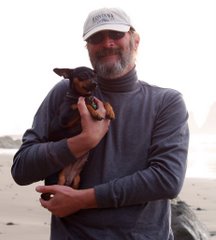
Poppa & Hans (My favorite photo of my dad)
Taken in the early 1970s near Stevensville, Montana


Events from  our drive to Madras brought all this back to mind, triggering these memories as it were.  As regular readers know, I am putting together a photo book on Montana's fifty-six counties.  At this point, I have completed the photographic work, and am finishing the writing.  Once this project is done, I want to do similar books on Idaho, Washington and, yes, Oregon.  Madras is the county seat of Jefferson County, and this trip would allow me to get photos of the Jefferson County sign, the county court house, and at least some images of the scenic beauty of the county.  Now I hate taking pictures from a moving car.  They almost never come out the way I want, and focusing the camera while passing scenery at seventy miles per is just a bitch.  Besides, we have driven to Portland and beyond so many times, that there is very little I haven't already captured along that route.  On this trip, I didn't even pick up the camera until we had turned off the Interstate and were heading south on US 97.  At that point, I found that in a bit of supreme irony, I had forgotten my memory card.  The 16 gigabyte Toshiba SDHC memory card that usually resides inside my camera was, at that moment, in a slot on my computer at the gallery, over four hundred miles away.  Kevin, anticipating such memory lapses on my part, had insisted that I always carry a spare or three, and sure enough, even though I didn't have my camera bag along, the man bag I do carry had a Transcend 4 gig card, which I promptly inserted into the camera's slot.  It did not take long for me to become concerned, alarmed even.

I shot a few through the windshield shots just to capture the road and its twists, turns, rises and falls, and then my camera gave me a warning message.  The card needed to be formatted.  I've never before had that particular message appear,  The camera gave me the option of letting it format the card, so as I seemed to have no choice, I agreed.  With first Mount Hood then Mount Jefferson on the western horizon, I took picture after picture as we passed through Moro, Grass Valley and Shaniko.  Once in Madras, we found the court house and I got a few shots of that building.  Trying to get more shots of Mount Jefferson, the camera gave me a new error message, CHR.  I had no idea what this meant, but when I tried to review the pictures I'd already taken, the screen told me that there were no images in memory.  My camera had, apparently, forgotten the twenty-six shots I'd just taken over the past hour or two.  At this point, I still have not been able to view those photographs, even though when I insert the memory card into my computer, I can see that there are twenty-six images on the card, all with the correct "NEF" extension that Nikon uses to denote RAW images.  When I try to download the set, Adobe Bridge tells me that it cannot "obtain files from this device."  Should I try to load a single image into Photoshop, I get the message "Could not complete your request because it is not the right kind of document."  A scan of the card indicates that the files are "corrupted or unreadable."  This is not helpful.  Fortunately, there were no "one-of-a-kind" shots on the disk.  Anything that might have been there can be recaptured at another date.  All it requires is another trip to Madras, Oregon.

Not a view from Madras, but a similar one from further south on US 97
Taken 4/16/2007

In closing all I can say is that I'm glad I didn't insist that we take two side trips while visiting Jefferson County.  There is a bridge in the Peter Skene Ogden State Park on the Jefferson/Deschutes county line that I will need to document for my upcoming book on the bridges of Conde McCullough.  It's about twenty-five miles south of Madras, and thus would have added at least an hour to our drive.  The Cove Palisades State Park should offer plenty of scenic views where the Crooked, the Deschutes and the Metolius Rivers all come together in a lake behind Round Butte Dam.  This is just a few miles west of Madras.  Finally, the Crooked River National Grassland surrounds Madras and probably has at least a few places worth viewing and sharing.  None of these areas were among the shots now lost on the four gig card.

As I check things out at home, my Nikon Coolpix L3 tells me that it cannot use the 4 gig card.  The D80 has no trouble with other cards I had at home nor with the 16 gig card it normally uses, now that I've retrieved that from the gallery computer.  So at this point, I'm crossing my fingers and saying that the problem was the card and not the camera.  It's much easier to replace a twenty-dollar card than a thousand dollar camera.  Now if we could just find a way to replace the memory cards in our brain--after, of course, backing up and saving the information of the existing memory.

On the Jefferson/Wasco County Line, US 97, Central Oregon
(Taken with my iPhone--always carry a backup, right?)